
Estimated reading time: 7 minutes
Key Takeaways
- Avoid Passport Deposits: Never leave your actual passport as collateral; choose shops that accept copies or cash deposits.
- Choose the Right Bike: Use 125cc scooters for the city, but upgrade to 150cc+ (NMAX, PCX) for mountain trips like Doi Inthanon.
- Digital Nomad Efficiency: Long-term scooter rentals are significantly cheaper and more convenient than relying on Grab or Songthaews.
- Legal & Safety: Always ride with a helmet and ensure you have an International Driving Permit (IDP) with a motorcycle stamp to satisfy police and insurance.
Table of Contents
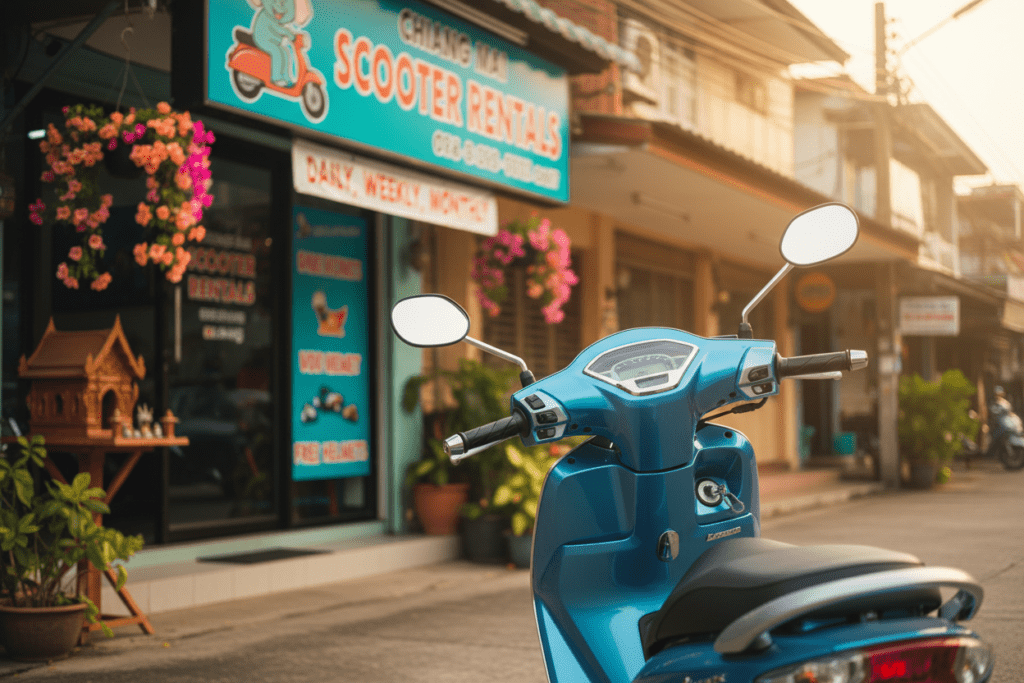
When you’re planning a trip to Northern Thailand, finding a reliable Chiang Mai Scooter Rental is often the first item on the to-do list, and for good reason.
You land, the humidity hits you, and you realize that the best stuff isn’t within walking distance.
But here’s the thing.
The rental game here can be sketchy. I’m talking about passport deposits.
You know the drill. You walk into a shop, and they ask for your actual passport as collateral. It feels wrong because it is wrong. You should never hand over your most important travel document to a stranger renting out 125cc bikes.
Beyond the passport anxiety, there’s the issue of maintenance. You don’t want to be halfway up a mountain when you realize your brakes are merely “suggestions” rather than functional mechanical parts.
That is why I always tell people to look for modern solutions. You want a bike, not a hostage negotiation.
This is where Byklo.rent changes the dynamic completely.
Unlike the street-side shops where you have to haggle and surrender your ID, Byklo allows you to book online. No passport holding. No weird hidden fees. Just a bike that works and a booking process that feels like it belongs in 2024, not 1995. The peace of mind you get from knowing your passport is safe in your hotel safe? Priceless.
Check out what others say about avoiding hassles with general Chiang Mai Scooter Rental on TripAdvisor.
Why Two Wheels is the Best Way to Travel
If you don’t ride, you’re only seeing half of the city.
Seriously.
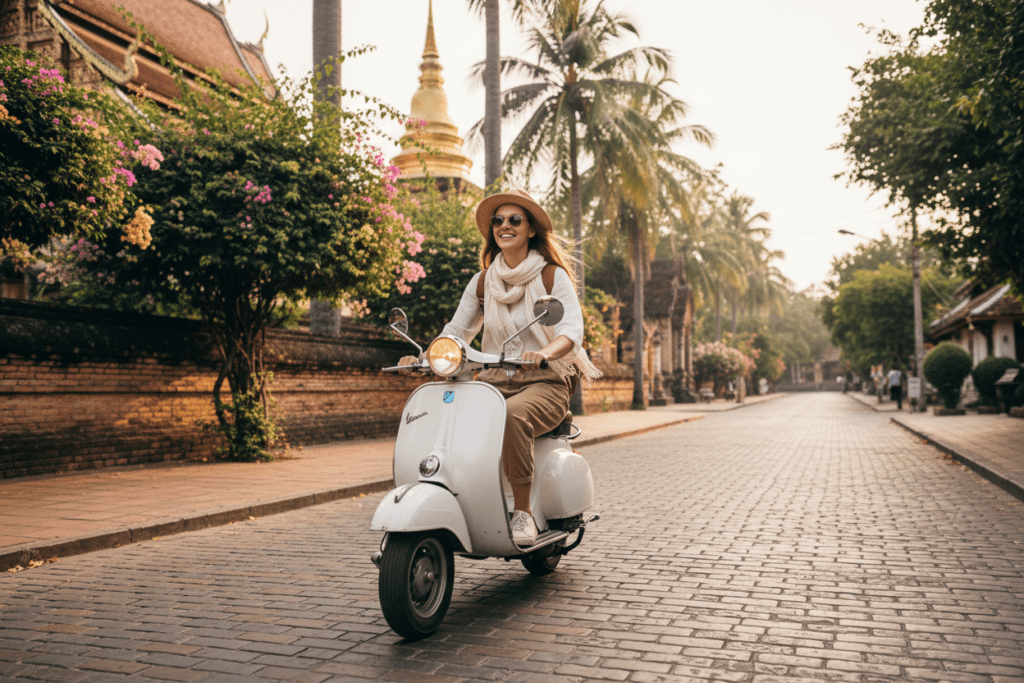
Opting for a motorbike rental in Chiang Mai gives you the freedom that Songthaews and TukTuks cannot provide.
Let’s talk about the “Red Trucks” (Songthaews) for a second. They are iconic, sure. But they run on their schedule, not yours. You have to flag them down, negotiate a price, and wait while they pick up twelve other people.
It’s fine for a quick hop, but it kills your momentum.
When you have your own scooter, the city unlocks. You can wake up at 5:00 AM and ride up to Doi Suthep to watch the sunrise over the city before the tour buses arrive. The air is cool, the road is winding, and it’s just you and the asphalt. Learn more about temple rides in Exploring Chiang Mai’s Temples by Motorbike.
Then there are the hidden spots. The Sticky Waterfalls (Bua Tong), one of many you can find in our Top 10 Waterfalls Near Chiang Mai to Ride to by Motorbike. The Grandma’s Cafe deep in the hills of Mon Jam. The grand loop of Samoeng.
The Samoeng Loop specifically is a rite of passage. It’s about 100 kilometers of twists, turns, and coffee stops. Doing this in a car feels sterile. Doing it on a bike feels like flying. For a detailed route and guide, check out our Exploring the Samoeng Loop: Chiang Mai’s Most Popular Motorcycle Ride.
You need the right tool for the job, though.
If you are just putting around the Old City, a Honda Click 125 or a Scoopy is perfect. They are light, nimble, and sip fuel like a polite tea drinker.
But if you are a bigger person, or you plan on tackling the steep gradients of Doi Inthanon (the highest point in Thailand), you might want to step up. A Yamaha NMAX or a Honda PCX gives you that extra stability. They have ABS brakes, wider tires, and actual storage space for more than just a water bottle.
If you’re feeling adventurous, the Honda ADV is the beast you want. It eats up the potholes that the monsoon season leaves behind.
Getting the right bike matters. It’s the difference between struggling up a hill at 20km/h while cars tailgate you, and cruising up with power to spare.
You can read more about the types of bikes and routes for scooter rental in Chiang Mai on Bikago.
The Old City and Getting Around the Hubs
Chiang Mai is laid out like a square inside a map.
That square is the “Old City,” surrounded by a crumbling brick wall and a moat. It’s beautiful. It’s historic.
And it is hot.
Many travelers specifically look to rent a motorbike in Chiang Mai Old City because it is the heart of the action. This is where the Sunday Walking Street happens. This is where the ancient temples like Wat Chedi Luang sit.
But the geography can be deceptive.
On a map, the walk from Thapae Gate to Wat Phra Singh looks easy. In the midday sun, with 90% humidity, it is a death march. For insider tips on navigating it, see our Chiang Mai Old City Guide: 1-Day Itinerary & Scooter Tips.
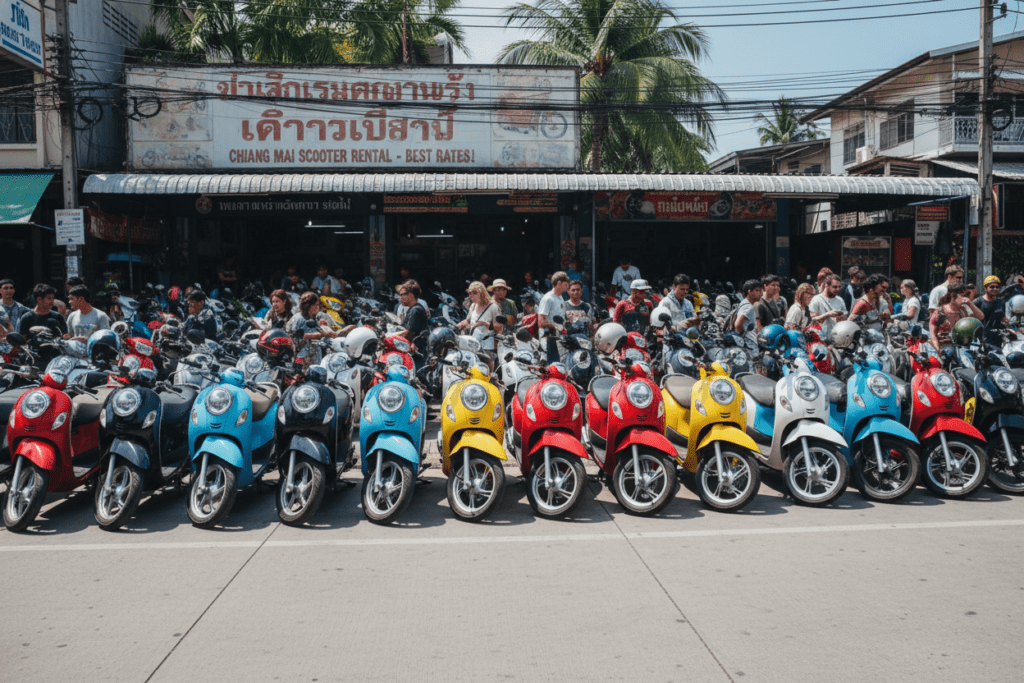
So, the standard tourist move is to walk from rental shop to rental shop in the heat, trying to find a bike.
You walk into one place. “No bikes left.”
You walk to the next. “Only have old bikes with 50,000 kilometers.”
You walk to a third. “Passport deposit required.”
It’s exhausting. You end up settling for a subpar bike just to get out of the sun.
Don’t do this.
There is a massive difference between the Old City and Nimman. Nimman is the trendy area—fancy condos, digital nomad cafes, Maya Mall. Only about 15 minutes away by bike, but an eternity if you’re walking.
You want to zip between these hubs. You want to grab a Khao Soi in the Old City for lunch, then head to a coworking space in Nimman, and maybe finish the day at a Jazz bar by the Riverside.
This functionality relies entirely on having transport ready to go.
Instead of the “sweaty shop crawl,” you can use Byklo.rent to hack the logistics. Imagine booking your ride before you even leave your hotel room.
Better yet, imagine the bike coming to you.
Byklo offers arrangements where the vehicle is ready when you are. It’s a transactional shift. You aren’t begging a shop owner for a favor; you are securing a service.
It saves you arguably the most valuable currency you have on a short trip: Time.
For the Long-Term Stayers: Digital Nomads
If you are here for a week, you are a tourist. If you are here for a month or more, you are likely working.
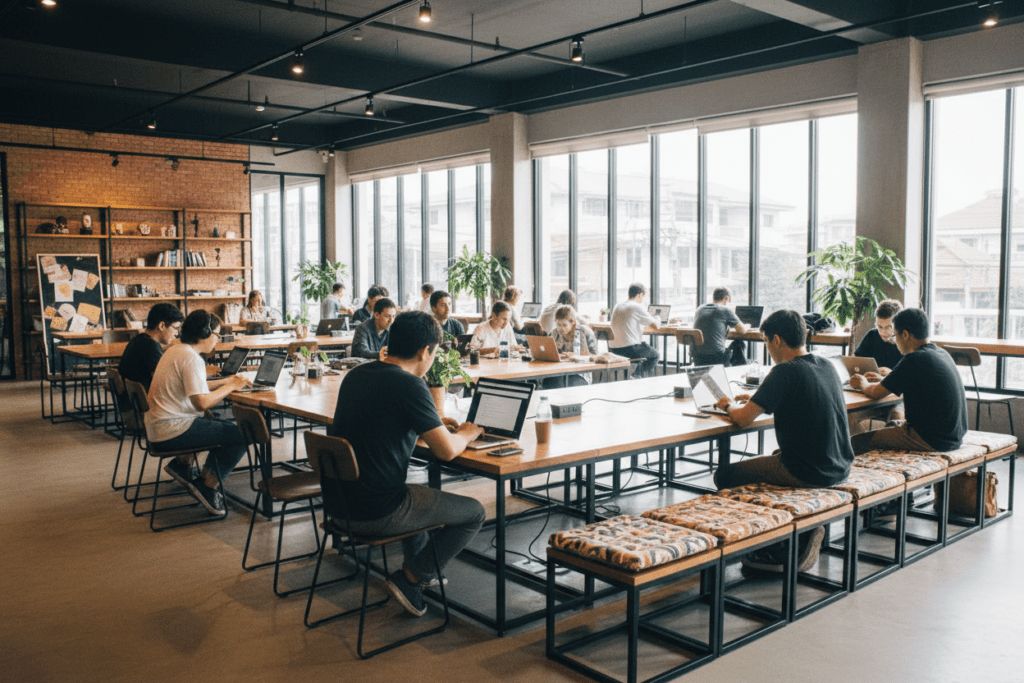
Chiang Mai is arguably the capital of the Digital Nomad world. The internet is fast, the coffee is strong, and the living cost is low.
But reliable digital nomad transport in Chiang Mai is about more than just getting from A to B; it’s about budget and lifestyle.
When you are living here, your needs change.
You aren’t just driving to a waterfall once. You are commuting. You are going to the gym (probably GoGym or Play). You are going to Yellow Coworking or Alt_ChiangMai. You are doing grocery runs to Rimping Supermarket.
You need reliability.
A tourist can tolerate a bike that struggles to start for three days. A nomad cannot. If your bike doesn’t start, you miss a meeting or lose a morning of productivity.
You also need storage.
Living out of a backpack means you are often carrying your laptop. You want a bike with decent under-seat storage so you don’t have to carry a heavy bag on your sweaty back in 35-degree heat.
Let’s talk about the “Grab Trap.”
I see so many nomads arrive and say, “I’ll just take Grabs. It’s cheap.”
Is it?
A Grab bike ride is maybe 60-80 Baht. A car is 150+. If you go to lunch, the gym, and dinner, you are taking 4 to 6 rides a day. That can easily hit 400-500 Baht a day.
That is 15,000 Baht a month. Just on moving around.
Compare that to having your own bike parked downstairs. You have total autonomy. You can leave your apartment at 2 AM to find a 7-Eleven toastie without waiting for a driver.
It changes your relationship with the city. You stop calculating the cost of leaving your apartment.
And for the nomads, fuel economy matters. The difference between a well-tuned modern injection engine and a beaten-up carburetor clunker adds up over 30 days.
For nomads, Byklo is essentially the fleet manager you didn’t know you needed. You get the reliability of a corporate fleet with the ease of an app. Plus, budget-savvy nomads can explore savings with our Motorbike Rental Chiang Mai: 7 Insider Secrets That Can Save You $200+ Per Week.
Monthly Rentals and Cost Breakdown
Let’s get into the math, because this is where you save the real money.
Securing a monthly scooter rental in Chiang Mai is the most cost-effective strategy for anyone staying longer than two weeks.
Daily rates in the city might hover between 250 to 400 Baht depending on the bike and the season.
Do the math on 30 days at 300 Baht. That’s 9,000 Baht.
But monthly rates are drastically lower. You get a bulk discount that brings the daily cost down significantly.
However, you have to watch out for the “Hidden Economy” of street rentals.
Here is a nightmare scenario I have seen happen:
You rent a cheap bike for a month from a random shop because it was 500 Baht cheaper than the reputable place.
You ride it. You park it. Someone scratches it at the night market. It’s a tiny scratch. You barely notice it.
When you return the bike, the shop owner points at the scratch and demands 2,000 Baht. Or they claim the tire is worn out and you need to pay for a new one.
Since they have your passport (remember the intro?), you have zero leverage. You pay the extortion fee just to get your document back so you can fly home.
Suddenly, that “cheap” rental is the most expensive mistake of your trip.
This brings us back to transparency.
With Byklo.rent, the contract clarity is the main feature. You aren’t guessing what the terms are.
Contract Clarity means you know exactly what you are paying for.
Also, maintenance support is vital for monthly rentals.
Bikes have moving parts. Oil needs changing. Tires lose pressure. Brakes wear down.
If you rent from a reputable source like Byklo, maintenance is part of the package. If the bike feels weird, you get support. You aren’t left figuring out how to explain “the engine is making a clunking sound” in Thai to a mechanic on the side of the road.
And crucially, no “foreigner fees.” The price is the price.
You can see typical cost breakdowns and policies at Zippy Motorbikes.
Essential Requirements and Safety (Trust Signals)
Alright, let’s get serious for a minute.
Riding in Thailand is fun, but it’s real life. It’s not a video game. The traffic flows like water—it finds the path of least resistance.
To survive and thrive, you need to play by the rules.
First, the Police Checkpoints.
They are everywhere. Usually set up near the corners of the Old City moat or on the road to Doi Suthep.
The police are looking for one thing: Your License.
To ride legally, you need an International Driving Permit (IDP).
Specifically, you need an IDP stamped for motorcycles.
If you have a car license back home and get an IDP for a car, it does not count. The police will check the stamp. If you don’t have the stamp, you pay a fine. Usually 500 to 1,000 Baht. You pay it in cash, get a receipt, and ride on.
But here is the kicker: Insurance.
If you crash and you don’t have a valid motorcycle license, your travel insurance will likely invalid your claim. Medical bills in Thailand are cheap compared to the US, but expensive if you need surgery.
Don’t risk it. Get your IDP before you leave home.
Second requirement: Helmets.
It is the law. It saves your life.
But not all helmets are created equal. The “soup bowl” helmets provided by cheap rental shops offer zero protection. They are basically plastic hats.
Byklo puts a huge emphasis on safety standards. When you rent through them, you aren’t getting a cracked helmet from 2015. You get gear that actually fits.
And the bikes themselves.
Safety starts with the vehicle condition.
I’ve ridden street rentals where the mirrors flopped down every time I hit a bump. I’ve ridden bikes where the rear brake was so loose you had to squeeze it all the way to the handlebar to slow down.
That is dangerous.
Byklo’s fleet is maintained to a high standard. The tires have tread. The brakes bite. The lights work.
They also offer insurance options at checkout. This isn’t just about vehicle damage; it’s about peace of mind. If you drop the bike (it happens to the best of us), you aren’t panicking about the cost.
Before you hit the road, don’t miss our Top 10 Tips for Staying Safe While Riding a Motorbike in Thailand to ensure you’re prepared for any situation.
Conclusion & Call to Action (CTA)
Chiang Mai is a city that demands to be explored.
It hides its best secrets down narrow alleys and up steep mountain roads. To find them, you need wheels.
But the vendor you choose dictates whether that experience is stressful or seamless.
You can roll the dice with a street shop, hand over your passport, and pray the brakes hold. Or you can go the modern route.
You want a bike that starts every time.
You want to keep your passport in your pocket.
You want a contract that makes sense.
Stop researching and scrolling through forums wondering who to trust. The solution is right in front of you.
Check availability and book your scooter today with Byklo to secure the best bike for your trip.
Do it now, so when you land, all you have to worry about is which temple to visit first.
Frequently Asked Questions
Do I need a motorcycle license to rent a scooter in Chiang Mai?
Technically, yes. To drive legally in Thailand, you need a valid driver’s license from your home country plus an International Driving Permit (IDP) stamped for motorcycles. While rental shops may not check this, the police frequently do.
Should I leave my passport with the rental shop?
No. You should avoid shops that require you to leave your actual passport as a deposit. Reputable services like Byklo.rent allow you to book online or use a copy/cash deposit system, keeping your travel documents safe.
How much does it cost to rent a scooter in Chiang Mai?
Daily rentals typically range from 250 to 400 Baht depending on the model (125cc vs 155cc). Monthly rentals offer significant discounts, often bringing the daily average down to 200 – 300 Baht.
What is the best scooter for two people?
If you are riding with a passenger or planning to visit the mountains (Doi Suthep, Doi Inthanon), it is highly recommended to rent a Honda PCX (150/160cc) or Yamaha NMAX (155cc). These bikes offer better power, larger seats, and superior braking compared to smaller 110cc – 125cc models.


