Key Takeaways
- The Route: The 130km journey to Pai features 762 curves, requiring technical riding skills and absolute focus.
- The Equipment: Renting a 150cc motorbike (like a PCX or NMAX) is crucial for safely handling steep inclines and braking.
- Scams: Avoid the “rental mafia” by documenting bike condition with video and using vetted platforms like Byklo.rent.
- Documentation: A valid home motorbike license and an International Driving Permit (IDP) are required for insurance and legality.
Table of Contents
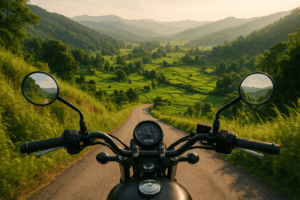
There is a specific smell that greets you about 20 kilometers outside of Chiang Mai. It isn’t just the scent of burning brakes from the minivans ahead of you, nor is it just the fresh ozone of the jungle rain. It’s the smell of anticipation. You are about to tackle Route 1095.
For motorbike enthusiasts and backpackers alike, this stretch of asphalt is legendary. It is a rite of passage in Northern Thailand. We aren’t just talking about a commute from point A to point B; we are talking about the first leg of the Mae Hong Son Loop, a journey that has broken as many travelers as it has made. The road to Pai is beautiful, exhausting, exhilarating, and, quite frankly, dangerous if you don’t respect it.
The difference between a nightmare journey involving a pickup truck rescue and the best road trip of your life usually comes down to one decision: your Pai Loop scooter rental.
I have ridden this road more times than I can count on two hands. I’ve seen seasoned riders slide out on gravel patches because they got cocky, and I’ve seen total novices make it safely because they prepared correctly. This guide isn’t just about getting a bike; it is about surviving the 130 kilometers of tarmac that stands between you and the laid-back vibes of Pai.
We are going to talk about the curves, the mechanics of the bikes, the scams you need to sidestep, and how to secure the right machine before you even land in Thailand.
The Challenge: The Reality of 762 Curves
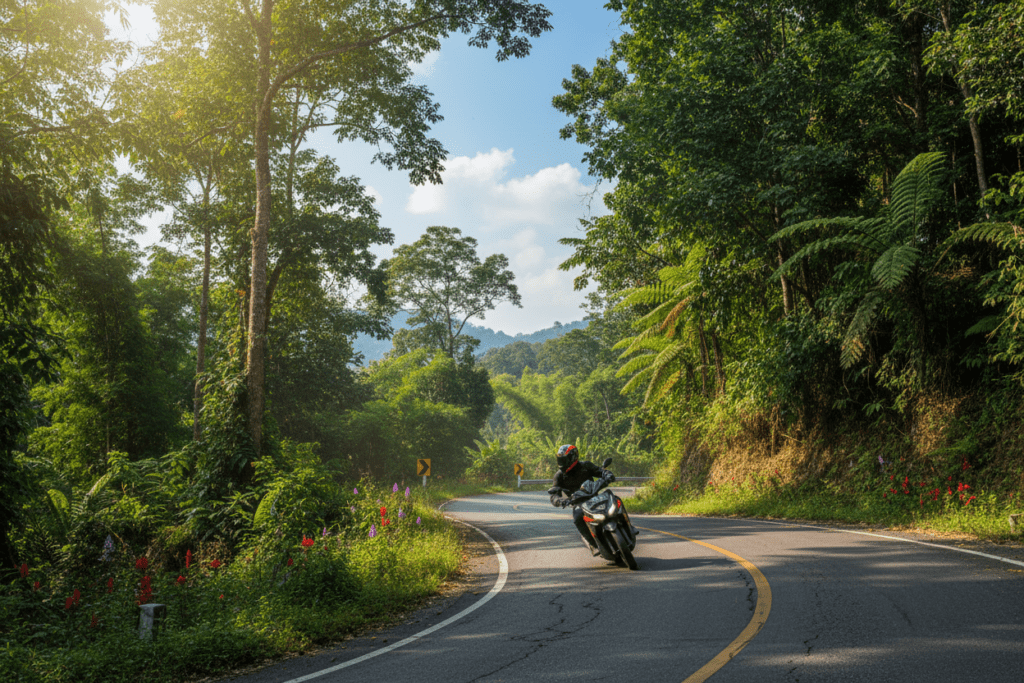
Let’s address the elephant in the room immediately. You will hear the statistic everywhere: 762 curves. It sounds like a marketing gimmick printed on t-shirts in the Pai Night Market (and it is), but on the road, it is a physical reality.
To put that number in perspective, the distance is only about 130 kilometers. That averages out to roughly six curves every kilometer. You are rarely going straight. You are constantly leaning, braking, accelerating, and counter-steering. For three to four hours, your focus has to be absolute.
The issue with 762 curves Pai safety isn’t just the number of turns; it is the geometry of them.
These aren’t gentle, sweeping highway bends. Many of them are sharp switchbacks that fold back on themselves while simultaneously climbing a 12% grade. If you have only driven a scooter on the flat islands of Koh Samui or the grid streets of Chiang Mai, this is a different beast entirely.
The Terrain Breakdown:
- Variable Surface: The asphalt is generally decent, but tropical rains can wash gravel onto the road mid-corner. I have hit patches of sand on blind corners that made my heart stop.
- The Banking: Some corners are positively banked (helping you turn), but others are off-camber, meaning the road slopes away from the turn, trying to push your tires outward.
- The Public Transport: This is the biggest hazard. The minivans ferrying tourists to Pai are on a tight schedule. They know the road by heart, and they cut corners. It is not uncommon to come around a blind hairpin and find a Toyota Commuter van halfway in your lane.
If you are going to ride this, you need a technical strategy. Here is what actually works:
- Brake Early: Do nearly all your braking while the bike is still upright, before you enter the turn. If you grab a handful of front brake while you are leaned over, physics will take over, the front tire will tuck, and you will slide.
- Outside-Inside-Outside: Approach the curve wide (near the center line for left turns, near the shoulder for right turns), cut to the apex (the inside) of the curve, and drift wide as you exit. This smoothes out the sharpness of the turn and gives you better visibility of what’s coming.
- Throttle Control: Once you let off the brakes and start leaning, crack the throttle open slightly. This settles the suspension and gives the bike stability.
But here is the brutal truth: You can have the skills of a MotoGP rider, but if your equipment fails, gravity wins. I have seen backpackers attempting this route on rental bikes that looked like they were held together with duct tape and prayers. If your brake pads are worn down to the metal, or your tires are bald, those 762 curves become a game of Russian Roulette.
This is where preparation meets survival. Savvy travelers don’t just walk into a random shack and point at the cheapest bike. They verify the maintenance records. This is why platforms like Byklo.rent have become essential for this specific trip—it filters out the shady operators who neglect their fleets.
The Power Equation: Why “Cheap” is Dangerous
A common mistake I see in Chiang Mai is travelers asking for the cheapest possible bike. They end up with a 110cc Honda Scoopy or a Yamaha Fino.
In the city, these bikes are fantastic. They are nimble, fuel-efficient, and cute. On the road to Pai, they are a liability.
When you search for the best bike for Pai loop, the answer almost always involves engine displacement. Here is the physics behind it: climbing a mountain requires torque. A 110cc or 125cc engine produces very little torque. To get two people and two backpacks up a steep incline, you have to twist the throttle 100% open and hold it there for twenty minutes straight.
This does two things:
- Overheating: The engine runs incredibly hot. I have seen belts snap and engines seize halfway up the mountain because they were pushed beyond their limit.
- Lack of Control: When you are at full throttle just to maintain 20km/h, you have no reserve power to overtake a slow truck or maneuver out of a dangerous situation. You are a sitting duck.
If you want to do this safely, my strongest advice is to rent motorbike Pai 150cc.
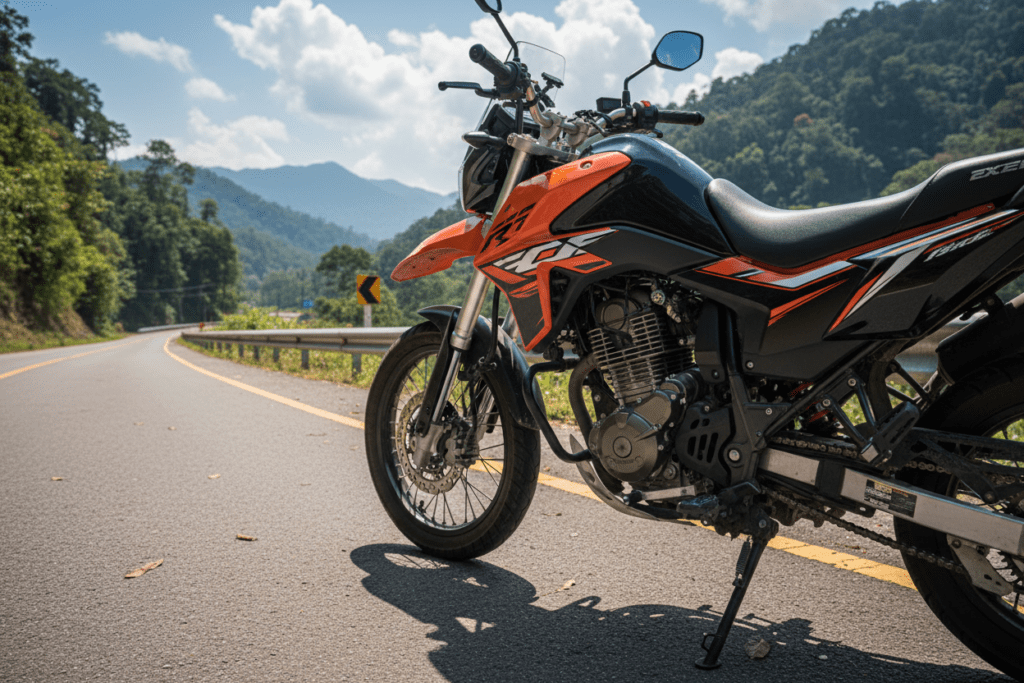
Using a bike like a Honda PCX 160 or a Yamaha NMAX 155 changes the experience entirely. These machines have liquid-cooled engines that are designed to run at highway speeds. They have the torque to pull you up the hill without screaming in protest.
Here is a direct comparison of how these bikes handle the Loop:
| Feature | 110cc/125cc (Click, Scoopy) | 150cc+ (PCX, NMAX, ADV) |
|---|---|---|
| Uphill Power | Struggles. Max speed 20-30km/h on steeps. | Effortless. Maintains 50-60km/h easily. |
| Braking | Usually drum brakes on the rear. Fade quickly. | often Disc brakes front & rear. ABS common. |
| Suspension | Soft, bouncy. Unstable in rough corners. | Stiff, stable. Absorbs bumps mid-corner. |
| Tire Width | Thin. Less contact patch with the road. | Wide. Better grip in corners and wet roads. |
| Comfort | Cramped. Saddle sore after 1 hour. | Touring seat. Legs can stretch out. |
I want to highlight the Braking row in that table. Many 150cc models come with ABS (Anti-lock Braking System). On a mountain road where you might hit slick oil or wet leaves, ABS prevents your wheels from locking up during a panic stop. It is, without exaggeration, a lifesaver.
However, finding these specific models can be a hassle. Walk-in shops often push whatever inventory they have left, which is usually the battered 110cc scooters nobody else wanted. This is why booking in advance matters. By using Byklo.rent, you can specifically filter for 150cc models like the NMAX or PCX. You lock in the specific class of bike you need, ensuring you don’t show up to a garage only to find the safe options are sold out.

Navigating the “Rental Mafia”: Scams and Reliability
Thailand is known as the Land of Smiles, but the motorbike rental industry has a shadowy underbelly. We have all heard the stories. You rent a bike, have a great trip, and return it only to be accused of scratching a panel that was already scratched. The shop demands 5,000 THB (about $150 USD) for a plastic part that costs $10.
Or worse, the “Mechanical Failure” scam. The bike breaks down in the middle of nowhere because it hasn’t had an oil change in three years. You pay a truck to bring it back, and the shop blames you for breaking the engine, demanding you pay for a replacement.
These aren’t urban legends; they happen every day in tourist hubs like Chiang Mai.
The root cause is usually the shop’s business model. Some budget shops rent bikes for barely enough money to cover the cost of the bike, hoping to make their real profit on “repair fees” from tourists.
How to protect yourself:
- The 360 Video: Before you touch the bike, turn on your phone’s flashlight and take a 4K video of every inch of the machine. Zoom in on existing scratches. narrate the video. “Scratch here on the front fender, crack here on the mirror.” Do this in front of the staff. It signals that you are not an easy target.
- Check the Tires: Look at the tread depth. If the tire looks bald in the center, refuse the bike. It won’t grip on the wet mountain roads.
- Test the Brakes: Before you leave the lot, squeeze both brakes hard. They should feel firm, not spongy. If the lever touches the handlebar, the brakes are shot.
For more comprehensive safety advice, check out our Top 10 Tips for Staying Safe While Riding a Motorbike in Thailand.
This rigorous checking process is exhausting, which is why the industry is shifting toward vetted platforms.
This is the core value proposition of Byklo.rent. They don’t just list every shop; they curate partners who have verified maintenance schedules. When you book through a platform like Byklo, you essentially have a “big brother” in your corner. The shops know that if they try to scam a Byklo customer, they risk getting delisted from the platform, losing hundreds of future bookings. That leverage keeps them honest.
Furthermore, when you are halfway to Pai and your tire goes flat, having English-speaking customer support through the platform is infinitely better than trying to explain your location in broken Thai to a shop owner who stopped answering their phone.
The Pre-Ride Checklist: Document and Gear
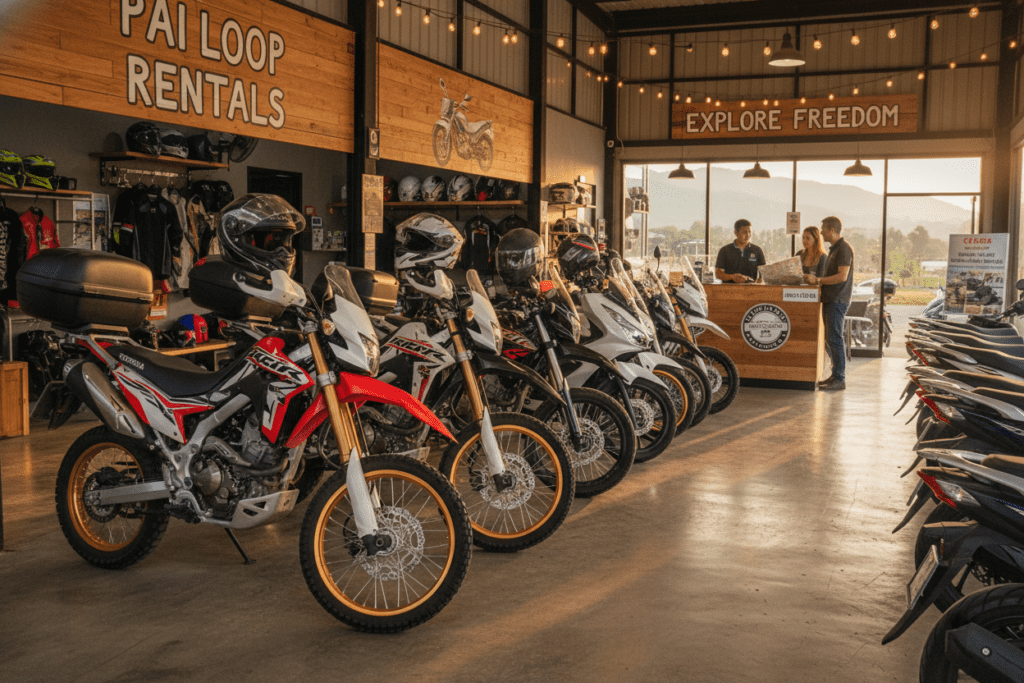
Okay, you have decided on the route, and you have selected a 150cc beast. Now you need to make sure you are legally and physically covered.
The International Driving Permit (IDP)
Let’s clear up the confusion. To legally drive a scooter in Thailand, you need a valid motorbike license from your home country AND an International Driving Permit (IDP).
If you only have a car license back home, technically, you are driving illegally on a scooter in Thailand.
Will the rental shop check? Usually, no. They just want your money.
Will the police check? Yes. There is famously a police checkpoint just outside the walls of the Old City in Chiang Mai specifically targeting tourists heading to Pai. If you don’t have the IDP with the motorcycle stamp, the fine is usually 500 to 1,000 THB. You pay it, get a receipt, and carry on.
However, the real risk isn’t the fine; it’s insurance. If you crash and end up in the hospital, your travel insurance company will ask to see your license. If you were driving illegally (no IDP/moto license), they will likely deny your claim. Medical bills in Thailand can stack up to tens of thousands of dollars instantly. Ride legal, or understand the massive financial risk you are taking.
The Deposit Dilemma
Standard practice in Thailand is to leave a deposit. Shops usually ask for your physical passport.
I never, ever recommend leaving your passport with a rental shop. Your passport is your only legal ID abroad. If the shop burns down, or the owner holds it hostage over a dispute, you are in serious trouble.
Most reputable shops will accept a cash deposit instead (usually 3,000 to 5,000 THB). If a shop insists on the passport and refuses cash, walk away. Utilizing Byklo.rent can streamline this. Because the booking is prepaid and identity-verified online, the friction regarding deposits is often lower, and the terms are clearly stated before you arrive.
Gear Up properly
Do not be the person riding to Pai in a tank top and flip-flops. We call that “meat crayon” dressing. If you go down at 40km/h on asphalt, skin disappears instantly.
- Helmets: The “free” helmets provided by shops are often plastic bowls with zero padding. Check the strap. If you shake your head and the helmet wobbles, it is too big. If possible, buy your own certified helmet in Chiang Mai ensuring a proper fit. It costs $40 and protects your brain.
- Eyes: Visors are crucial. At 60km/h, a large beetle hitting your eye feels like a rock. If your helmet lacks a visor, wear sunglasses.
- Skin: Wear linen trousers or jeans and a light jacket. It protects you from the sun (which is brutal at altitude) and offers a layer of abrasion resistance.
The Itinerary: Don’t Rush the Experience
Finally, remember that the Pai Loop is not a race track. The beauty of a Pai Loop scooter rental is the ability to stop whenever you want.
Plan for the trip to take about 4 to 5 hours. This allows for:
- Engine Cooling: Give the bike a break. If you feel the engine heat radiating intensely, pull over for 15 minutes.
- Mork Fa Waterfall: Located about an hour into the drive, this is a perfect place to cool off and wash away the road dust. Explore other nearby cascades in our Pai waterfalls guide.
- The Witch’s House (Coffee): There are several quirky cafes on the ridgelines. Stop, drink a terrifyingly strong iced coffee, and capitalize on the views.
The journey back is often more dangerous than the journey there. You are tired, perhaps hungover from the Pai nightlife, and you think you know the road now. That is when accidents happen. Treat the return leg with the same respect as the departure.
Conclusion: Make the Right Choice
The road to Pai involves navigating 762 curves, dodging minivans, and mastering your machine. It is an adventure that earns you stories you will tell for decades. It is the feeling of dropping into a valley as the sun sets, the air cooling down, smelling the woodsmoke from the villages, and feeling the bike hum beneath you.
But that memory is contingent on safety. It relies on the bike starting when you push the button. It relies on the brakes biting when a dog runs into the road.
Don’t gamble your trip on a beat-up 125cc scooter from a roadside stand just to save three dollars. Professionalize your adventure.
Prioritize power. Prioritize maintenance. Prioritize safety.
Ready to secure your ride? Head over to Byklo.rent now. Search for your dates, filter for a 150cc model, and lock in a bike from a top-rated provider. When you are carving through curve number 500 with a grin on your face and a responsive throttle in your hand, you will be glad you did.
Frequently Asked Questions
How long does it take to drive from Chiang Mai to Pai?
The drive typically takes between 3 to 5 hours depending on your riding speed, traffic, and how many stops you make. It is recommended to take your time and enjoy the views.
What size motorbike do I need for the Pai Loop?
A 150cc motorbike or larger (like a Honda PCX or Yamaha NMAX) is highly recommended. Smaller 110cc or 125cc scooters often struggle with the steep inclines and may overheat with two passengers.
Do I need a license to rent a motorbike in Thailand?
Yes. To ride legally and be covered by insurance, you need a valid motorcycle license from your home country and an International Driving Permit (IDP) stamped for motorcycles.
Is the road to Pai dangerous?
The road contains 762 curves and can be dangerous due to steep grades, other traffic, and varying road conditions. However, with a well-maintained bike and careful riding, it is a manageable and rewarding experience.