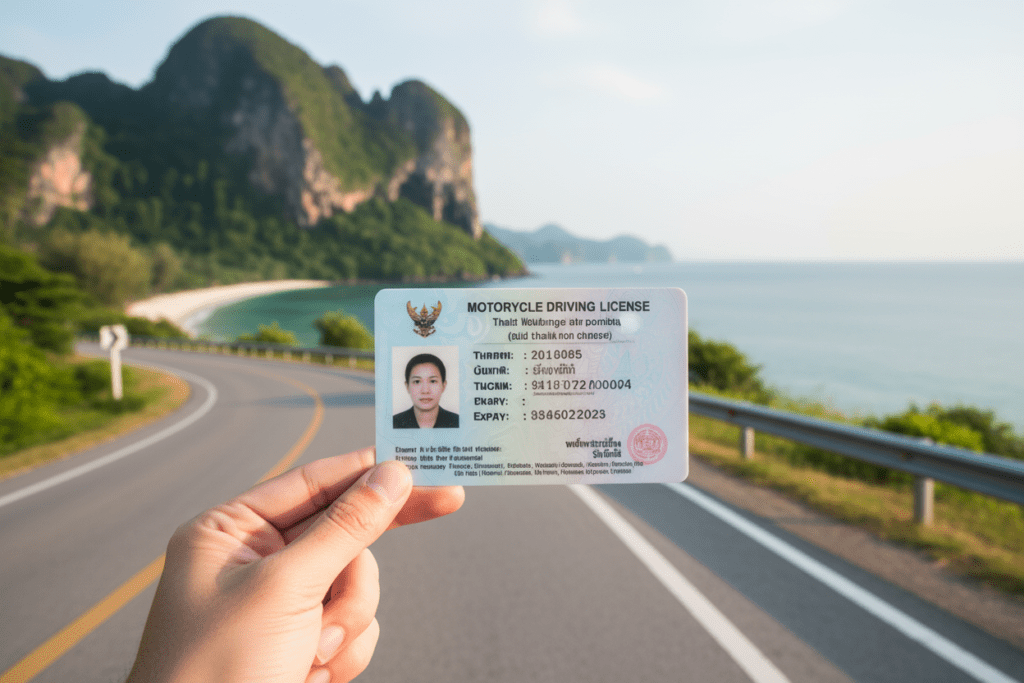
Estimated reading time: 7 minutes
Key Takeaways
- Tourists: Must carry a valid Home Country License plus an IDP with the “A” (motorcycle) endorsement.
- Expats: Staying over 60-90 days requires converting to a Thai license, which in 2025 may require passing a theory test.
- No Exemptions: There is no 50cc loophole; a full motorcycle license and helmet are mandatory for all scooters.
- Required Documents: Passport, Visa, Residence Certificate, and Medical Certificate are essential.
- Cost: Getting legal costs under 1,000 THB, significantly less than repeated police fines.
Table of Contents
We all have that specific daydream about Thailand. You know the one. You’re cruising down a coastal road in Krabi, the sun is setting, the air is warm, and you have total freedom. It’s the ultimate travel fantasy.
But let’s pour a little cold coffee on that dream for a second.
Here is the reality: Police checkpoints are everywhere. Insurance companies are looking for any reason to deny your claim. For tips on protecting yourself, read our Motorbike Rental Insurance Thailand guide which breaks down coverage tiers and deductibles. And the rules in 2025 are stricter than they have ever been. If you get into a crash without the proper paperwork, you aren’t just looking at a ruined holiday; you’re looking at potential financial ruin.
That is why you are here. You need to know how to do this legally.
This Thai Motorbike License 2025 Guide is going to break down everything you need to know. If you need inspiration on where to ride once you’re fully legal, see our Exploring Thailand on Two Wheels – Your Guide to Motorcycle Adventures blog. We aren’t going to sugarcoat it. The bureaucracy can be annoying. The queues are long. But the peace of mind you get from being fully legal? That is absolutely worth it.
Whether you are here for a two-week vacay or setting up life as an expat, the rules have shifted. The police are savvy to the old “I didn’t know” excuses. They have heard it all before. To ride lawfully in 2025, you must have the correct plastic in your wallet.
For most of us, the difference between a dream trip and a nightmare comes down to valid documents.
Short-term tourists face different requirements than long-term expats. But regardless of how long you stay, safety should be your priority. While many roadside shops will rent you a bike with zero questions asked, that doesn’t mean you should take it. Reputable platforms like Byklo.rent prioritize user safety by verifying that you have the right mindset for legal compliance. This isn’t just about avoiding a 500 Baht fine; it’s about ensuring that if the worst happens, your insurance remains valid rather than being voided because you didn’t have a license.
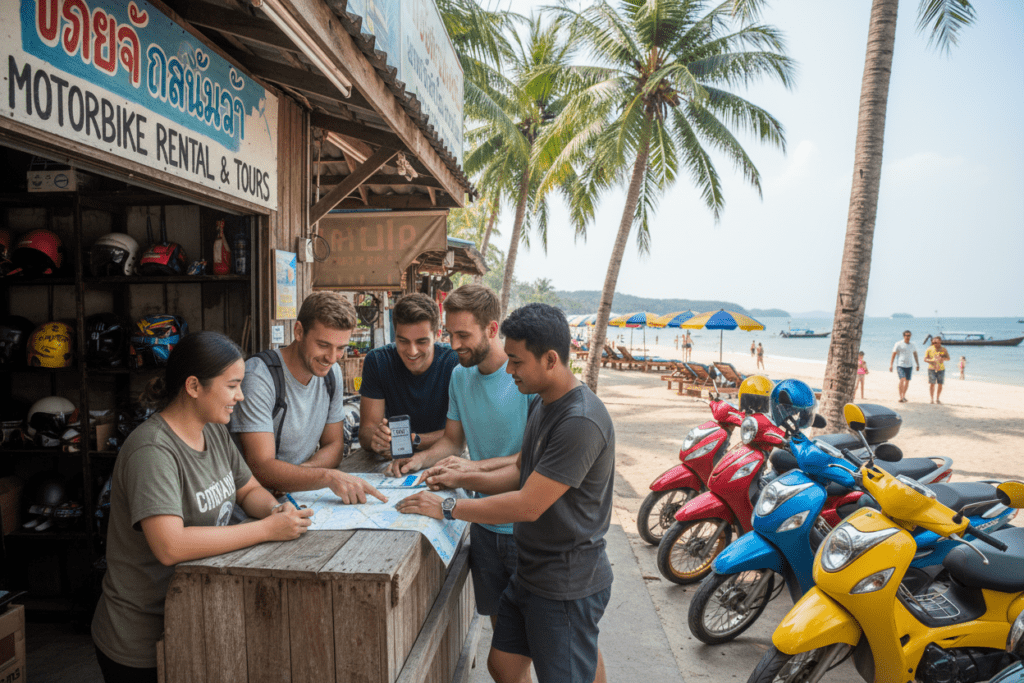
Tourists vs. Expats: What You Actually Need
There is typically a massive amount of confusion surrounding what counts as a “license” here. Let’s clear the air.
If you are reading forums from 2018, close them. They are outdated.
The rules depend entirely on how long you plan to stay in the Kingdom. The police treat a two-week tourist differently than a six-month resident, at least on paper. But in practice, the document checks are exactly the same.
The Rules for Short-Term Tourists (Under 90 Days)
If you are here for a holiday, you generally do not need to go through the hassle of getting a local Thai license. However, you cannot just ride on your home country’s driver’s license alone.
You need a specific combination of documents:
- Your valid Home Country License.
- An International Driving Permit (IDP).
Here is the catch that catches everyone out. Your home country license must have an “A” endorsement.
If you are from the UK, Europe, or Australia, look at the back of your card. If the motorcycle icon is not stamped or valid, you are not legal to ride a scooter in Thailand. An automobile (Category B) license does not cover you for two wheels here, no matter what the guy at the rental shop tells you.
Many tourists assume their car license covers small scooters. It doesn’t. If you crash a scooter while holding only a car license, your travel insurance will almost certainly deny your claim based on incorrect license category.
Also, check your IDP. It needs to be valid effectively for the vehicle class you are operating. Police in places like Phuket and Chiang Mai target tourist areas specifically checking for this “A” stamp.
The Rules for Expats (Over 60-90 Days)
If you are staying longer, the IDP is just a temporary bandage. It is not a permanent solution. Legally, after 60 to 90 days (depending on your visa type and specific interpretation of the Traffic Act), you are expected to convert to a local Thai license.
In the past, converting a foreign license to a Thai one was easy—just show the papers and get the card.
2025 Update: Things are tightening up. New directives suggest that foreigners may now need to pass the written theory test even when converting a valid foreign license. You can’t just swap cards anymore; you have to prove you know the local road rules.
Thailand Scooter License Rules: Busting the Myths
Let’s address the “50cc exemption” rumor. You hear this all the time in hostel bars. “Oh, you don’t need a license for a 50cc scooter.”
Wrong.
In Thailand, there is no 50cc exemption. There is no “automatic scooter” loophole. Whether you are riding a beastly 1000cc Africa Twin or a humble 110cc Honda Scoopy, the law considers them both motorcycles. You need a full motorcycle license.
And regarding thailand scooter license rules, don’t forget the helmet. It is mandatory for both the rider and the passenger. It is the single easiest way for police to spot you and pull you over.
Requirements and Documents (The “Before” Phase)
So, you are going to do it. You are going to get legal. Smart move.
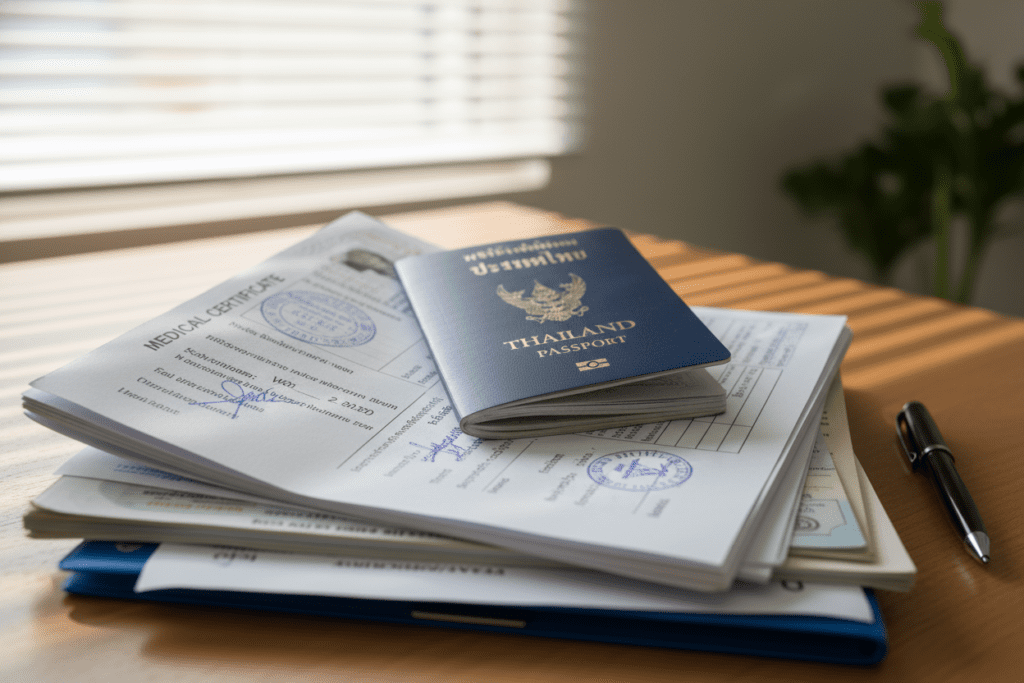
Before you even think about going to the Department of Land Transport (DLT), you need to assemble your paperwork. The DLT is a government office. They love paper. If you are missing one copy, one signature, or one stamp, you will be sent home.
Here is exactly how to get thai driving license paperwork sorted.
1. The Passport and Visa
You need your original passport and copies of the relevant pages (photo page, current visa, entry stamp).
Crucial Note: Generally, you cannot get a Thai driving license on a standard 30-day Tourist Visa “Exempt” stamp. You usually need a Non-Immigrant Visa (like an Education, Business, or Retirement visa). However, some DLT offices are lenient, and some agents can help tourists get temporary 2-year licenses. It varies by province.
2. The Certificate of Residence
This is often the biggest hurdle for newcomers. You need an official document proving where you live. You cannot just show them your Agoda booking or an electric bill.
You have two main options to get this:
- Thai Immigration: Go to the local Immigration office with your landlord’s documents (signed rental contract, copies of their ID, and their House Book/Tabien Baan). They will issue a residence certificate. It usually costs about 300-500 THB and can take anywhere from a few hours to a few weeks depending on the office.
- Your Embassy: Some embassies provide an affidavit of residence. This is usually faster but much more expensive.
3. The Medical Certificate
This is the easiest part. Walk into almost any local clinic and ask for a driving license medical certificate. They will check your blood pressure, ask if you are color blind, and listen to your heart.
It takes ten minutes. It costs between 100 and 200 THB. Make sure it is not older than 30 days when you go to the DLT.
4. Copies, Copies, Copies
Thailand runs on signed photocopies.
You need copies of everything stated above. And you need to sign every single page in blue ink.
- Passport photo page.
- Visa page.
- Entry stamp.
- TM.6 departure card (if you still have one).
Pro Tip: Make two full sets of copies. If you decide to apply for both a car and motorbike license at the same time (which you should, if eligible), you need two completely separate sets of documents. They file them separately.
Obtaining that Residency Certificate can sometimes take a few days of waiting. It’s dead time. But you can use that downtime productively. While you handle the administrative paperwork, you can secure your ride in advance. Visit Byklo.rent to browse available motorbikes, ensuring that once your license is in hand, a high-quality bike is ready for you immediately. Also, use our Motorbike Rental Thailand Guide to compare bike types and rental processes.
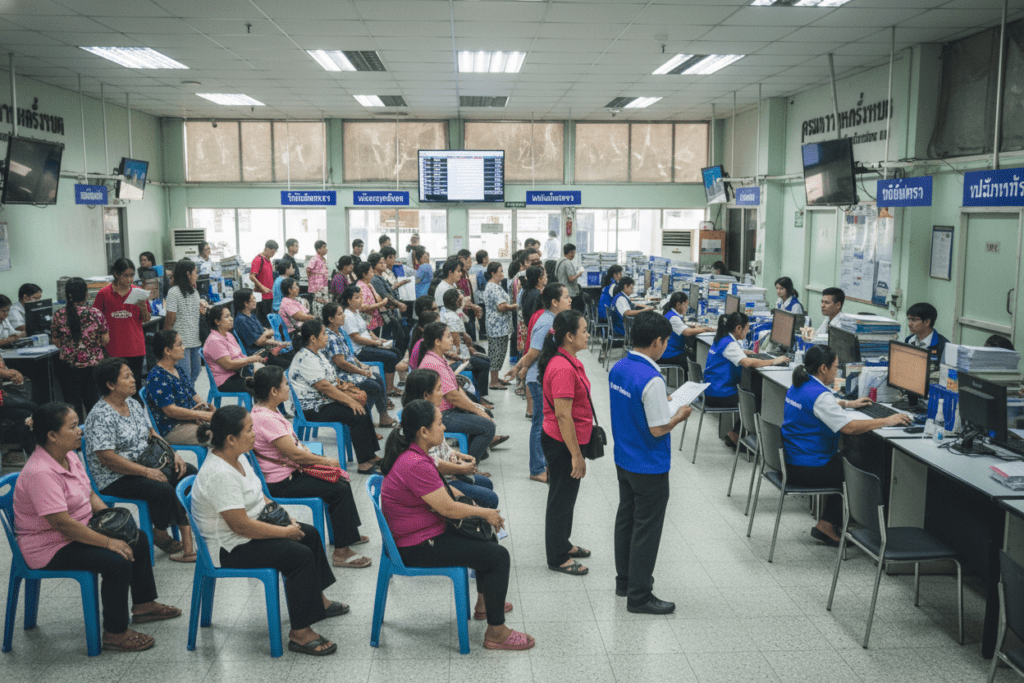
The Step-by-Step Application Process (2025 Update)
Alright, you have your folder of documents. You have your coffee. You are ready to face the DLT.
Here is what the Thai motorbike license 2025 application process actually looks like on the ground.
Step 1: The Booking
Do not just show up. In 2025, walk-ins are theoretically possible at some remote offices, but in Bangkok, Chiang Mai, or Phuket, you will likely be turned away.
You need to download the “DLT Smart Queue” app. It’s available on both iOS and Android. Register with your passport details and book an appointment for a “New Driver’s License.” Be warned: in busy areas, the next available slot might be a month away. Plan ahead.
Step 2: The Physical Tests
The morning of your appointment, dress respectfully (shoulders and knees covered). When your number is called, you will undergo a series of physical aptitude tests.
- Color Blindness: You will look at a chart or a traffic light simulator and identify the colors red, yellow, and green.
- Depth Perception: This is the tricky one. You use two buttons to align a moving pin with a stationary pin in a small box. It requires a steady hand.
- Reflex Test: You sit in a simulator chair with a gas and brake pedal. Press the gas until the lights on the screen go red, then smash the brake instantly. You have less than a second to react.
Step 3: The Theory Training
If you pass the physicals, you move to training. Mandatory training involves watching a road safety video. It covers traffic signs, right of way, and graphical depictions of accidents.
For a new license, this video is usually about 5 hours long. It is long. It is repetitive. But it is mandatory. Pay attention, because the test questions come directly from this content.
Step 4: The Theory Exam (The Big Hurdle)
This is where people get nervous. You will sit at a computer kiosk to take the written exam.
- Format: 50 Multiple Choice Questions.
- Pass Mark: 45/50 (90%).
- Language: Available in English.
The English translations can sometimes be… quirky. You might have to read the question a few times to understand the logic. Passing score is 45 out of 50 questions, which leaves very little room for error. If you fail, you can usually come back the next day to retake just the exam without redoing the documents. For a comprehensive breakdown of the exam format, required documents, and fee schedule, see our Thai Driving License Requirements 2025 guide.
Step 5: The Practical Driving Test
If you pass the theory, you head to the driving track. You will need to rent a bike there (usually 50-100 THB) or use your own (if you can get it there legally).
The course is a calm, closed circuit. You will need to:
- Weave through pylons (slalom).
- Ride crossing a narrow elevated plank (balance).
- Stop at stop signs and use turn signals correctly.
It is not Moto GP. It is basic competency.
Step 6: The Digital Era
Once you pass everything, you pay your fee, take a photo, and get your card printed right there. In 2025, the DLT is also pushing the DLT QR License app, which gives you a digital backup of your license.
Financial Breakdown
One of the craziest things about this process is how cheap it is compared to the fines. People spend weeks avoiding the DLT, only to get fined 500 or 1,000 THB every time they leave their soi.
Let’s look at the motorcycle license thailand cost breakdown for 2025.
The official government fees are incredibly low.
- Motorbike Temporary License (2 Years): Approximately 105 THB.
- Motorbike Full License (5 Years): Approximately 255 THB.
- Medical Certificate: 100 – 200 THB.
- Residency Certificate: 300 – 500 THB (at Immigration).
Total Estimated Cost: Under 1,000 THB ($30 USD).
Now, compare that to the alternative.
- Police Fine: 500 THB to 2,000 THB per offense.
- Medical Bill (Uninsured): 100,000 THB to 5,000,000+ THB.
It is simple math. Getting the license pays for itself after dodging just two police checkpoints.
By obtaining your motorcycle license thailand cost effectively drops to zero compared to the recurring fines you’d pay without one. Use those savings to upgrade your rental experience—check Byklo.rent for premium scooters and motorbikes that offer better suspension and comfort than standard street rentals. You can take that extra cash and get a bike that actually handles the potholes well.
Renting with Confidence (The Conversion)
So now you are legal. You have the plastic in your pocket. You are untouchable at the checkpoints.
Now, where do you get the bike?
This is where many people make a mistake. They do the hard work of getting the license, then rent a scooter from a shady shack that keeps their passport in a drawer and rents out bikes with bald tires.
For a safe motorbike rental in Thailand, you need an agency that matches your level of professionalism.
Why Byklo is the Logical Choice:
- Maintenance: Street shops often run bikes into the ground. Byklo partners are vetted. The brakes work. The tires have tread. When you are riding in chaotic Thai traffic, mechanical reliability is safety.
- Transparency: No hidden scratch fees. No holding your passport hostage. The contracts are clear.
- Support: They understand the needs of foreign riders. If you need documents for any reason, or help extending your rental, they are accessible.
Once you have your license, don’t risk your safety on a poorly maintained vehicle. Byklo.rent aggregates the best local rental shops, ensuring that every bike meets safety standards. Plus, their transparent booking process means you know exactly what you’re getting—perfect for the conscientious rider who just passed their test.
Frequently Asked Questions (FAQ)
I get asked these questions constantly. Let’s do a rapid-fire round to cover the specific details about the Thai motorbike license 2025.
Q: Can I rent a bike without a license?
Physically? Yes. Many shops want your money more than they care about the law. But legally? Absolutely not. You are riding illegally, and you are personally liable for everything that happens.
Q: Does my car license cover a scooter?
No. A thousand times, no. This is the most common myth. Your “Category B” (Auto) license implies you can drive a Toyota Vios. It does not certify you to ride a Honda Click. If you crash, insurance claims are denied immediately.
Q: How long is the license valid?
When you first pass your test, you receive a “Temporary” license valid for 2 years. Before it expires, you go back to the DLT to renew it. The renewal gives you a “Full” license valid for 5 years.
Q: Do I have to retake the test for renewal?
Usually, no. If you renew before it expires (or shortly after), you typically just need to do the physical reaction tests and watch a shorter video (1 hour). You skip the written and driving tests.
Conclusion
Getting a Thai driving license is a rite of passage. It involves early mornings, confusing paperwork, and a little bit of sweat. But the reward is freedom.
Real freedom.
The freedom to ride past a police checkpoint with a smile and a wave. The freedom to explore the mountains of Mae Hong Son without worrying about your travel insurance policy. The freedom to know you are doing it right.
If you follow the steps in this guide, it is not actually that hard. It is just a process. Prepare your documents, book your queue, and keep a cool head.
Now that you know how to get a Thai driving license, you’re ready to hit the road legally. Start your journey by finding the perfect motorbike on Byklo.rent, where verified quality meets rider convenience.
Ride safe, keep the rubber side down, and enjoy Thailand the way it was meant to be seen—from two wheels.