Estimated reading time: 7 minutes
Key Takeaways
- High Risk Period: The “Seven Dangerous Days” (Dec 27 – Jan 5) see a spike in accidents, with motorbikes involved in over 82% of cases.
- Strict Documentation: Police checkpoints are frequent; you must have a valid International Driving Permit (IDP) and a proper helmet.
- Booking Strategy: Quality bikes sell out weeks in advance. Using verified platforms prevents renting unsafe, poorly maintained vehicles.
- New Year’s Eve: Avoid riding between 10 PM and 4 AM due to intoxicated drivers and chaotic traffic conditions.
Table of Contents
If you are prioritizing Thailand Motorbike Safety New Year plans, you are already ahead of the curve compared to most travelers landing in Bangkok or Phuket this December. Thailand during the New Year is electric—the air is thick with the smell of charcoal grills, the sound of fireworks, and a tangible sense of freedom that makes you want to jump on a bike and vanish into the sunset.
But we need to have a serious, honest conversation before you twist that throttle.
There is a reason the Thai government and local media refer to the period between December 27 and January 5 as the “Seven Dangerous Days.” This isn’t just a catchy headline; it is a statistical reality. During the 2026 New Year period, authorities reported a staggering spike in road incidents, with motorbikes accounting for 82.67% of all accident cases.
The numbers are sobering. According to recent reports, there were 436 fatalities and 2,467 accidents nationwide in just a ten-day window. That is the environment you are riding into. It doesn’t mean you shouldn’t ride—riding is still the best way to see the country. For more on staying safe on Thai roads, see our Top 10 Tips for Staying Safe While Riding a Motorbike in Thailand. It means you have to be smarter, sharper, and better prepared than the average tourist.
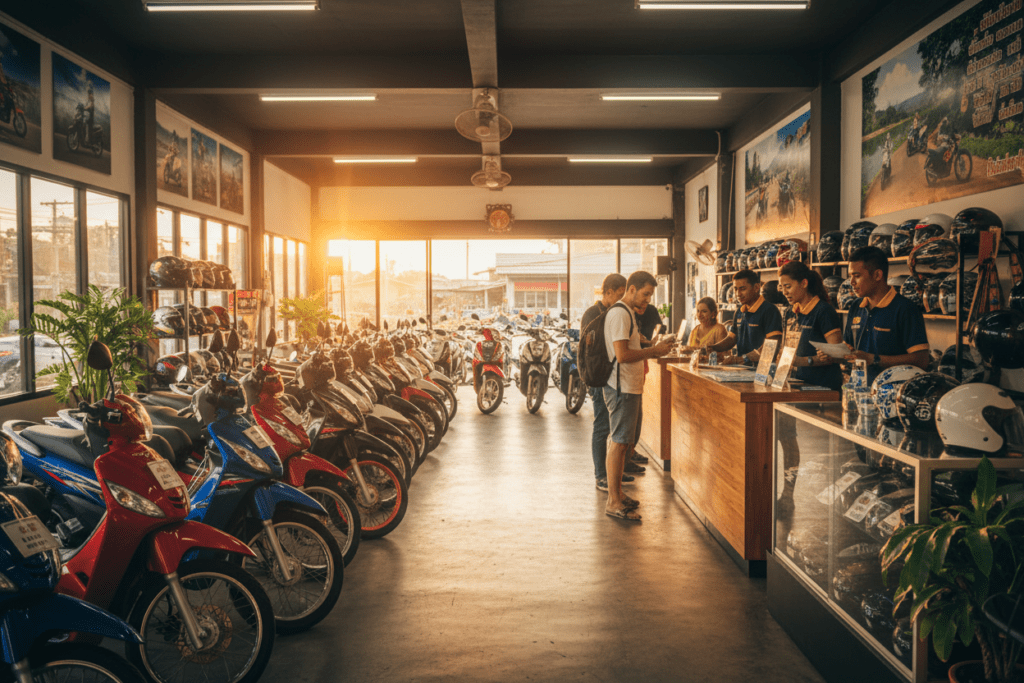
One of the biggest hidden risks during this period is actually vehicle scarcity. When demand skyrockets, quality drops. I’ve seen it happen a dozen times: the reputable shops rent out their Honda Clicks and PCXs weeks in advance. What’s left for the last-minute walk-ins? The older bikes. The ones with bald tires, loose brakes, and spotty maintenance histories.
Experienced travelers know that safety starts with the machine itself. Securing a bike usually involves booking weeks ahead to ensure you aren’t left choosing between a scooter that won’t start and one that won’t stop. This is why platforms like Byklo.rent have become essential for the holidays—they verify the inventory so you aren’t gambling with mechanics while you’re trying to navigate the holiday rush.
A safe holiday relies on three pillars: understanding the heightened traffic risks, knowing the police enforcement protocols, and ensuring the mechanical integrity of your bike. Let’s break them down.
Navigating the Holiday Rush: Traffic and Laws
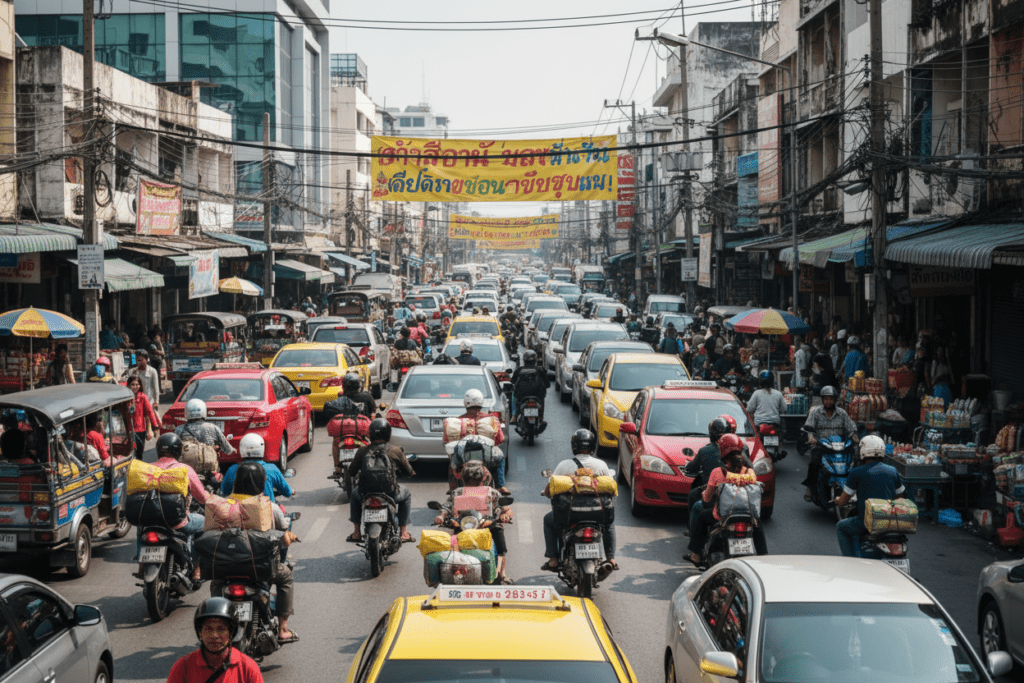
The first thing you’ll notice when you hit the tarmac is the sheer volume of people. Understanding thailand holiday traffic rules and the unwritten flow of the road is critical when millions of locals are driving home to their provinces and tourists are flooding the islands.
The roads change during the holidays. Highways that are usually navigable become arteries of congestion, and island roads—normally sleepy—turn into frantic raceways. Major routes out of Bangkok and into hotspots like Chiang Mai or Phuket see traffic density triple.
The Speed Trap
Excessive speed is consistently cited as the number one cause of crashes during the holiday window. It’s easy to get swept up in the momentum. You see a local rider zooming past at 80km/h on a shoulder, and you feel the urge to match that pace. Don’t.
The flow of traffic in Thailand is deceptively fast. On an island, 50km/h feels slow until a dog runs out from a 7-Eleven or a pickup truck pulls a u-turn without looking. During New Year, the mix of drivers changes. You are sharing the road with people who are tired from long drives, potentially intoxicated, or tourists who have never ridden a scooter before. Check your speedometer frequently. If you are riding comfortably, slow down by another 10%.
The Art of “Lane Discipline”
If you come from a country where lanes are strictly observed, you are in for a culture shock. However, there is a system here. “Lane Discipline” in Thailand generally means keeping as far to the left as possible unless you are overtaking or turning right.
Reckless lane changes contribute to nearly 25% of incidents during the deadly week. I vividly remember watching a tourist weave from the left shoulder to the right lane to bypass a tuk-tuk, only to be clipped by a fast-moving Fortuner coming up from behind.
The Golden Rules of Lane Discipline:
- Stay Left: The right lane is for speed. If you are on a scooter, you rarely belong there.
- No Sudden Moves: Predictability saves lives. If you need to turn, signal early (and check that your signal light actually works).
- The Blind Spot Check: Mirrors aren’t enough. A quick glance over the shoulder is mandatory before shifting position.
The Helmet Reality
You will see locals riding without helmets. You will see tourists with their shirts off and hair blowing in the wind. Ignore them. Helmet mandates are strictly enforced during the Seven Dangerous Days, but more importantly, the asphalt doesn’t care how cool you look.
This brings up a massive pain point with standard street rentals. Often, the helmet included with a cheap rental is a plastic “brain bucket”—a half-shell cap with a cracked visor and a loose strap. It’s barely legal and certainly not safe.
When you book through a vetted platform like Byklo.rent, the focus shifts from doing the bare minimum to actual rider safety. Quality partners provide proper, full-coverage helmets that fit correctly. If you get in a crash, a 200 Baht plastic cap isn’t going to help you. A proper helmet will.
Handling Law Enforcement and Documents
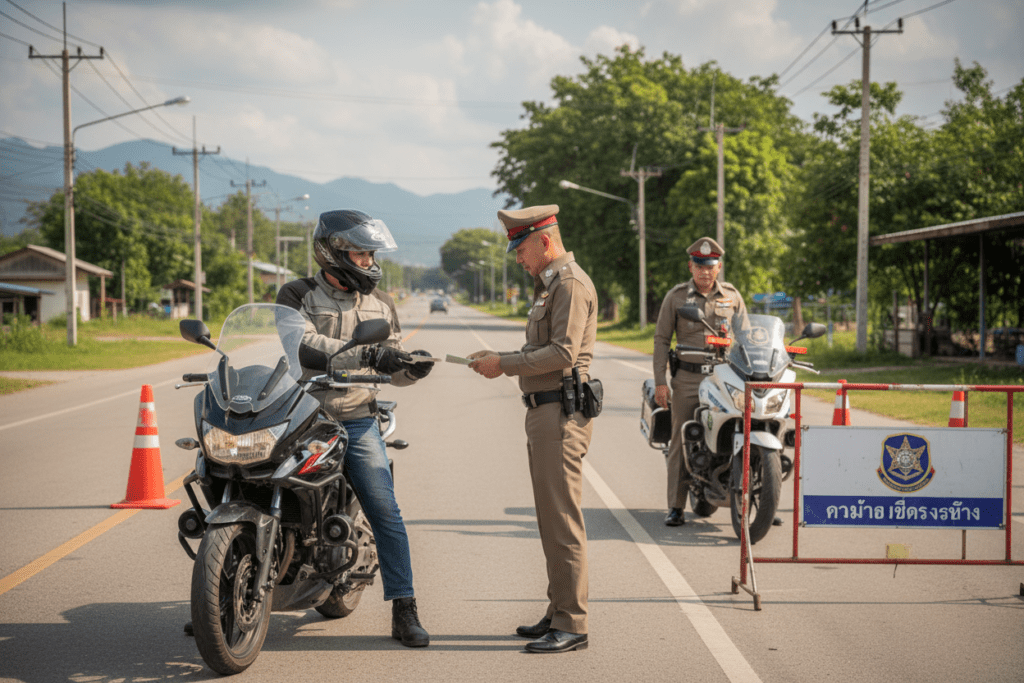
You should expect to encounter police checkpoints thailand holiday enforcement at a much higher frequency than any other time of year. These aren’t just random stops; they are a coordinated government effort to lower that accident statistic we talked about earlier.
The government intensifies police presence specifically to target drunk driving and verify vehicle legality. If you are riding in Phuket, Pattaya, Chiang Mai, or Koh Samui, you will likely pass through a checkpoint.
What Happens at a Checkpoint?
Legitimate checkpoints are usually set up on main roads during the day for document checks and at night for alcohol screening. Officers are looking for three things:
- Are you intoxicated?
- Are you wearing a helmet?
- Do you have a license?
When you are waved over, slow down, put your kickstand down, and take off your helmet / sunglasses. Being polite and calm goes a long way.
The Paperwork You Actually Need
There is a lot of misinformation online about what licenses you need. Let’s be crystal clear. To legally ride in Thailand and satisfy a police checkpoint, you need:
- Your Passport: Or a high-quality copy (though some officers insist on the original).
- Valid Home Country Motorbike License: A car license does not cover you for a scooter.
- International Driving Permit (IDP): This is non-negotiable. Learn how to obtain your International Driving License Thailand 2025: 6-Step IDP.
If you do not have a motorbike stamp on your IDP, you are technically driving without a license. The fine is usually between 500 and 1,000 THB, paid in cash at the station (or on the spot). But the bigger risk is that if you crash without a valid license, your travel insurance acts as if you don’t exist. They will deny your claim instantly.
Zero Tolerance and Vehicle Condition
Alcohol checks are frequent and serious. The days of bribing your way out of a DUI are rapidly disappearing, especially during the Seven Dangerous Days when high-ranking officials are scrutinized on accident numbers. Penalties include jail time, deportation, and massive fines. Just don’t do it.
However, there is another trap tourists fall into: Vehicle Documentation.
Police also check the condition of the bike. This includes the tax sticker (usually a square paper displayed on the bike) and the registration (Green Book).
I have seen tourists pulled over and fined because the rental shop gave them a bike with expired tax. The tourist ends up paying the fine for the shop’s laziness. This is another reason why seasoned travelers avoid the “mom and pop” shacks with signs written in Sharpie. Services like Byklo.rent ensure that every vehicle in the fleet carries up-to-date legal documentation. It saves you from standing on the side of the road arguing with an officer about a tax sticker that expired in 2023. For guidance on avoiding rental scams and extortion, check our Motorbike Rental Problems Thailand Guide.
Surviving the Big Night: Riding on NYE
The night of December 31st is the single most chaotic time on the roads. If there is ever a time to reconsider riding scooter new year’s eve, this is it.
I distinctly recall a New Year’s Eve in Koh Phangan. The excitement was palpable, but so was the danger. The roads were a mixture of sand, spilled drinks, and thousands of bikes.
The Midnight Cut-Off
My personal rule, and one I advise everyone to follow, is to park the bike before sunset on New Year’s Eve and leave it there until the next morning.
The hours between 10:00 PM and 4:00 AM are the danger zone. The roads are filled with revelers moving between parties. You might be sober, but the pickup truck coming around the blind corner might not be.
Parking Strategies
If you do ride to dinner or an event earlier in the evening, think about where you park. Popular zones like Patong Beach, Haad Rin, or Nimman Road in Chiang Mai become gridlocked.
- Avoid street-side parking in party zones: Drunk pedestrians knock bikes over like dominoes.
- Use paid lots: It is worth the 40 Baht to have a guard watching your bike.
- Lock it up: Theft isn’t rampant, but “borrowing” a bike because someone is drunk and lost their own is relatively common.
Defensive Driving on NYE
Defensive driving means assuming that every other vehicle is about to do something stupid.
- Watch the Surface: On islands, sand often washes onto the roads. At night, you can’t see it. Hitting a patch of sand while braking is a guaranteed way to lose skin.
- High Beams: Outside of the city, street lighting is inconsistent. If there is no oncoming traffic, use your high beams to spot potholes and wandering street dogs.
- The “Wobble” Factor: If you see a rider ahead wobbling or drifting, give them massive clearance. They are likely intoxicated.
Ultimately, the best advice for New Year’s Eve logistics is simple: Take a Grab, a Bolt, or a Songthaew. Let someone else worry about the traffic while you worry about the countdown.
Pre-Ride Checks and Rental Strategy
We have talked about how to ride, but we need to pivot to what you ride. This is motorbike rental safety tips 101.
Mechanical failure on a flat road is annoying. Mechanical failure on a steep downhill curve in Phuket is fatal. The wear and tear on rental bikes in Thailand is extreme. They are ridden hard, often by people who don’t know how to treat an engine, and they are exposed to salt air and humidity.
The Safety Checklist
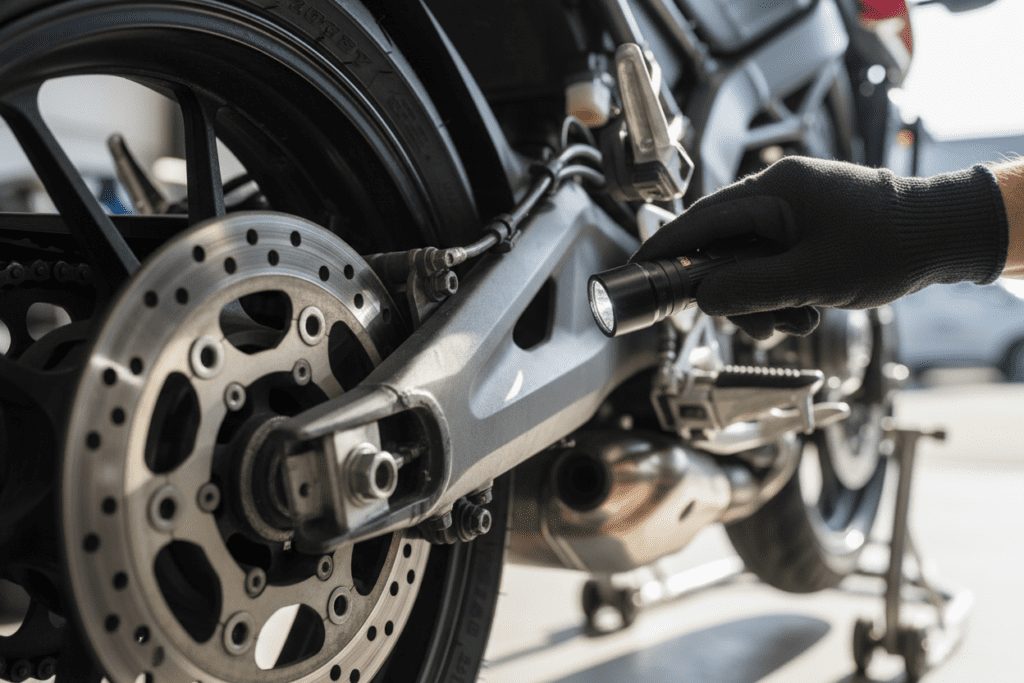
Before you sign that rental agreement and hand over your deposit, you need to perform a physical inspection. Do not let the shop owner rush you. For a quick step-by-step guide, refer to our Motorbike Rental Checklist Thailand: 5-Minute Inspection.
1. The Tires:
Look at the tread. Is it deep, or is the tire bald in the center? Run your hand over it (carefully). Uneven wear implies the bike has been crashed or has alignment issues. Bald tires on a wet or sandy road offer zero grip.
2. The Brakes:
This is the most critical check. Squeeze both brake levers.
- The Feel: They should feel firm, not “spongy.” If the lever touches the handlebar before the brake fully engages, refuse the bike.
- The Test: Sit on the bike and try to push it forward while holding the brakes. The wheels should lock completely.
3. Lights and Horn:
Start the engine. Check the headlight (high and low beam), the tail light, and the blinkers. You need to be visible. A non-functional brake light is dangerous because the car behind you won’t know you’re slowing down until it’s too late.
4. The Suspension:
Sit on the bike and bounce. It should settle and rebound smoothly. If it keeps bouncing like a pogo stick, or if it makes a loud clunking noise, the suspension is shot.
5. Maintenance History:
This is the hardest thing to verify at a street shop. Someone selling cheap rentals implies they are cutting costs, and the first cost to go is usually oil changes and brake pad replacements.
The Byklo Difference
The problem with the checklist above is that it requires you to have some mechanical knowledge. It also assumes you have other options if the bike fails the test. During New Year, when bikes are sold out, you might feel pressured to take a dangerous bike because it’s the only one left.
This is where the market has shifted. Savvy travelers are moving away from the “walk up and pray” method. By booking through Byklo.rent, you are essentially outsourcing the mechanical inspection to professionals. Byklo verifies the maintenance standards of its partners. It ensures that the tires have tread, the brakes bite hard, and the engine has been serviced.
It is the difference between hoping your bike is safe and knowing it is. When you are carrying a passenger up a 15% gradient hill, that peace of mind is priceless.
| Feature | Typical Street Rental | Verified Byklo Partner |
|---|---|---|
| Availability | First come, first served (often sold out) | Guaranteed reservation in advance |
| Helmet Quality | Cracked, thin plastic, no visor | Standardized, safety-checked helmets |
| Documents | Often expired tax/registration | Fully valid legal documentation |
| Maintenance | Fix it when it breaks | Preventative maintenance schedules |
| Pricing | Hidden fees or “foreigner pricing” | Transparent, fixed daily rates |
Conclusion
Thailand is one of the most spectacular places on earth to explore on two wheels. The freedom of twisting through jungle roads in Chiang Mai or cruising the coastal highways of Krabi is unmatched. But that freedom requires respect.
If you respect the reality of Thailand Motorbike Safety New Year, you can have an incredible trip. It requires acknowledging the “Seven Dangerous Days,” understanding that the laws are there to keep you alive, and realizing that road safety is a shared responsibility between the government and the rider.
Don’t become a statistic. Wear your helmet, stay legally compliant with your IDP, and never ride impaired.
Most importantly, don’t leave your vehicle choice to chance. The holiday rush means good inventory disappears fast. Don’t wait until you are standing on a humid street corner to find a ride. Secure a safe, insured, and designated motorbike now at Byklo.rent. Ensure your bike is ready and waiting for you, so the only thing you have to worry about is which beach to visit first.