Estimated reading time: 7 minutes
Key Takeaways
- Awareness is Key: Be alert to common scams like “mechanical blackmail,” usually involving pre-existing scratches or “stolen” bikes.
- Passport Safety: Never hand over your physical passport as a deposit. Look for shops that accept a cash deposit and a passport copy.
- Document Everything: Perform a thorough video inspection of the bike (the “CSI: Bangkok” method) before riding away to prove pre-existing damage.
- Vet Your Vendor: Use trusted aggregators like Byklo.rent to book with vetted, professional shops and ensure transparent pricing and dispute resolution.
Table of Contents
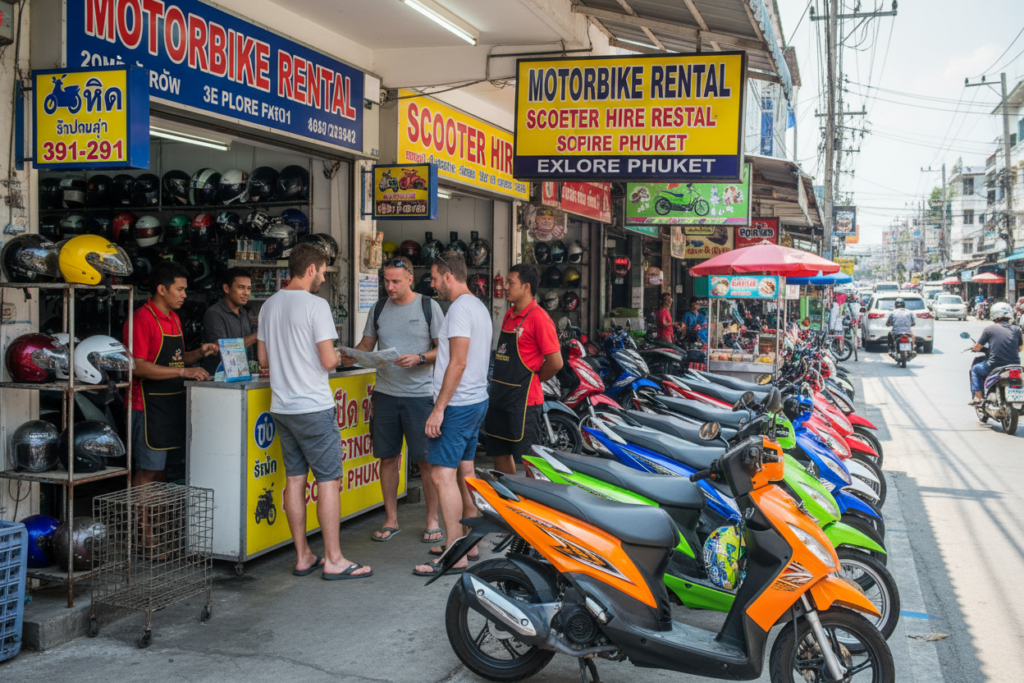
Picture this. You’ve just landed in Thailand. The air is warm, smelling faintly of sea salt and pad thai. You’ve dumped your bags at the hotel, and there’s only one thing on your mind: freedom.
There is absolutely nothing like exploring Thailand on two wheels. It’s the ultimate travel cheat code. You aren’t stuck in a minivan with twelve other people and broken air conditioning. You aren’t haggling with a tuk-tuk driver who insists on taking you to a suit shop instead of the temple. It’s just you, a full tank of gas, and the open road.
We are talking about access to everything from hidden beaches that Google Maps barely knows about to misty mountains in the north where the clouds touch the asphalt. It is the dream.
But I have to be real with you for a second.
That dream can get ugly fast if you aren’t careful. You might have heard the horror stories. Maybe you’ve seen the angry Facebook posts or watched a video of a tourist arguing with a shop owner who looks ready to throw a helmet.
We need to talk about Thailand Motorbike Rental Scams.
This isn’t to scare you off. I want you to ride. I want you to feel that breeze. But the reality is that in specific tourist hubs—places like Phuket, Pattaya, and Koh Samui—rental scams are a persistent problem. They turn what should be the highlight of your trip into a nightmare of police reports, lost money, and ruined vibes.
These scams aren’t just bad luck. They are calculated. They range from petty baseless claims about scratches to serious, organized fraud that can leave you stranded without a passport. You can read more about the nitty-gritty of these traps on Jeje Motorcycles.
The conflict here is simple: You want freedom. A shady rental shop wants your money, and they don’t care if they have to lie to get it.
But we live in the future, which is nice. You don’t have to roll the dice anymore.
This is where a little bit of modern tech saves your skin. I always tell people not to just wander into the first shop they see with a “For Rent” sign. It’s risky. Platforms like Byklo.rent exist effectively as a safety net for this exact reason. For a comprehensive overview of renting scooters in Thailand, check out our Thailand motorbike rental guide which covers everything from license requirements to pricing.
Think of it as a filter. Instead of walking in blind, you are connecting with shops that have already been vetted. You take the “stranger danger” element out of the equation. It removes that initial risk of handing your money to someone who might view you as a walking ATM rather than a customer.
So, grab a coffee. Let’s sit down and go through exactly how these scams work, so you can spot them a mile away and get back to the fun part—riding.
The Landscape of Fraud: Common Scams Explained
You need to know the enemy. And in this case, the enemy is usually a guy with a clipboard and a fake smile.
Most rental shops in Thailand are honest. They are family businesses just trying to make a living. But the bad apples? They are rotten to the core, and they tend to cluster in the areas with the most tourists.
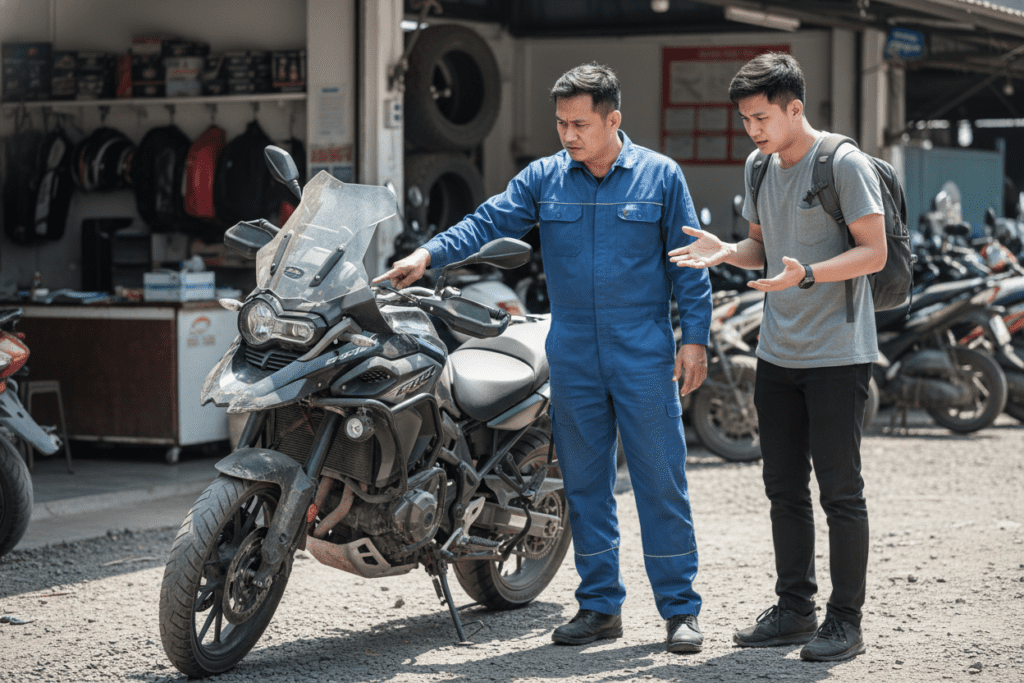
The most common trick in the book is what I call “Mechanical Blackmail,” or the damaged bike scam thailand.
It works like this: You rent a scooter. It’s not brand new. It’s got some wear and tear, maybe a few scratches on the fairing or a scuff on the mirror. You think nothing of it because, hey, it’s a rental. You ride it for three days, have a blast, and bring it back.
Suddenly, the mood changes.
The staff swarms the bike. They point to a scratch—the same one that was there when you picked it up—and accuse you of crashing. They act shocked. They act angry. And then they pull out a calculator.
They will quote you a repair price that is insane. We are talking hundreds of dollars for a plastic panel that costs ten bucks to replace. If you refuse to pay, things get heated.
This is why it’s critical to know that this damage often existed before you even arrived. Sometimes, the shop uses water-soluble paint or wax to hide old scratches. You wash the bike or ride through rain, the wax comes off, and voila—you “damaged” the bike. You can see how prevalent this is in this breakdown of common scams.
It gets worse, though.
There is a nastier version of this: The “Stolen” Bike. This is essentially an inside job.
You rent a nice bike. Maybe a Honda Click or partial big bike. You park it outside your hotel or at a night market. You lock the handlebars. You feel safe.
When you come back, the bike is gone.
Panic sets in. You go to the rental shop to report it. They demand you pay the full price of the bike immediately to replace it.
Here is the twist: The shop had a spare key. Someone from the shop followed you, waited for you to park, and simply rode the bike back to their warehouse. They stole their own bike back to charge you for the “loss.” It’s devastating and hard to prove. It’s a heavy topic, but you can see how sophisticated these setups are in this video about new scams in Thailand.
To understand the culture of this, you have to look at the bigger picture. It isn’t just motorbikes.
Have you heard of the jet ski scam thailand? It’s infamous in Phuket and Pattaya.
It’s the exact same mechanic. You rent a jet ski. You ride it for 30 minutes. You bring it back. The operators claim you cracked the hull or scratched the fiberglass. Suddenly, five or six big guys surround you on the beach demanding $1,000 USD. It is intimidation, plain and simple.
While we are focused on bikes, the existence of the Jet Ski scam proves that vehicle rental fraud is a systemic issue in certain Thai tourist spots. It’s a business model for gangs. If you want to read more on that landscape, check out this guide on staying safe in Thailand.
Lastly, watch out for the “Fake Fines.”
This one is weird but annoying. You might be parking your bike, and a “helpful local” or someone dressed in a uniform that looks official (but isn’t quite police) stops you.
They will tell you that you parked illegally, or that you broke a traffic rule, or that there’s a special “tourist tax” for parking there. They ask for cash on the spot.
Real Thai police write tickets. They don’t usually haggle for cash on the sidewalk (though that’s a whole other story). If someone demands cash without official paperwork, it’s likely a shakedown.
The Passport Hostage Crisis
If there is one rule I want you to tattoo on your brain, it is this: Never give anyone your passport.
Your passport is officially the property of your government. It is your only lifeline out of the country. It is your ID, your legal status, and your ticket home.
Yet, walking down the streets of Chiang Mai or Koh Tao, nearly every rental shop will have a sign that says: “Passport Required for Deposit.”
They want your physical booklet. They will put it in a drawer (or a shoebox) behind the counter and keep it until you return the bike.
This is the leverage point.
Remember the damaged bike scam we just talked about? If they have your passport, you have zero negotiating power.
If they say you owe them $500 for a scratch, and they have your passport, you are paying $500. You have a flight to catch. You can’t leave without that little blue book. They know this. They bank on this.
Holding a passport as collateral effectively takes you hostage. Additionally, if that shop burns down, or gets raided, or the owner just loses it, you are in a world of bureaucratic pain. You’ll be stuck in Bangkok dealing with embassies for weeks.
So, what do you do? You need to find a shop that lets you rent scooter thailand no passport.
You want a shop that accepts a photocopy of your passport plus a cash deposit. Usually, this deposit is between 3,000 and 5,000 Thai Baht (roughly $100-$150 USD).
It is a bit more cash up front, yes. But you get that cash back when you return the bike. If there is a dispute, the most you lose is the deposit—you don’t lose your ability to leave the country.
Finding these shops on the street can be exhausting. You have to walk from storefront to storefront, asking “Copy okay?” and getting rejected half the time.
This is another area where I lean on Byklo.rent.
One of the biggest headaches Byklo solves is the documentation negotiation. The partners they work with are selected for professional practices. Many of them operate with contracts that accept digital ID verification or standard cash deposits.
By booking through a platform that creates a digital paper trail, you avoid that awkward moment where a guy in a tank top demands to lock your passport in his desk. You keep your freedom in your pocket. You can read more about avoiding these hostage situations in this guide to scam-proofing your rental.
Essential Pre-Ride Protection Tactics
Okay, let’s say you are at the shop. You are looking at the bike. The keys are in your hand.
Do not just hop on and drive away.
The next five minutes are the most important five minutes of your rental. You need to perform a forensic investigation. I call it the “CSI: Bangkok” method.
You need to document everything. And I mean everything.
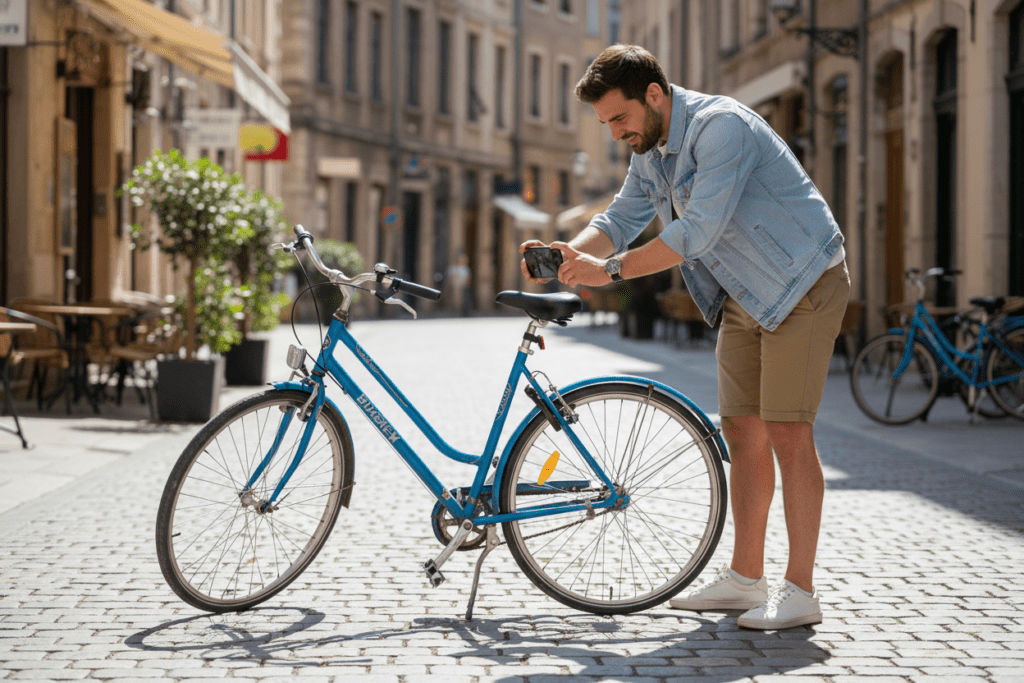
Take out your smartphone. Turn on the video camera. Set it to 4K if you have it.
Do a slow, continuous walk around the bike. We call this the 360-degree inspection.
Start at the license plate. Read it out loud for the video. Then move slowly. Film the exhaust pipe (look for scratches underneath). Film the mirrors. Film the brake levers—the ends of the levers are the first things to get scratched when a bike falls over.
Get low. Look at the fairings under the footrest. That is where rocks kick up and chip the paint. Open the seat. Film the inside storage area. Check the fuel level.
Narrate the video. “Okay, scratch here on the left panel. Dent here on the front fender.”
Make sure the rental staff sees you doing this.
This isn’t just about gathering evidence. It is psychological. When the staff sees you taking a high-resolution video, they know you aren’t an easy mark. You are signaling that you are smart and prepared. They are significantly less likely to try a safe motorbike rental thailand scam on someone who has indisputable video proof.
Don’t be shy. Be obvious.
There is a great visual guide on how to do this effectively. I highly recommend watching this video inspection tutorial before you go. You can also follow our detailed Motorbike Rental Checklist Thailand: 5-Minute Inspection for a step-by-step pre-ride walkthrough.
Once the video is done, look at the paperwork.
Never rely on a handshake. In Thailand, we love the friendly vibe, but business is business. You need a written agreement. It doesn’t have to be 50 pages, but it needs to state the rental dates, the cost, and the deposit amount.
If the shop refuses to give you a receipt or a contract, walk away. Immediately.
This brings me back to the selection process. You can do all this legwork on the sidewalk—inspecting bikes, arguing about contracts, checking tires in the hot sun. Or, you can filter for professionalism before you even leave your hotel room.
When you use Byklo.rent to find a safe motorbike rental thailand, you are effectively skipping the “is this guy shady?” phase. You still do your inspection (always do your inspection), but you are doing it on a bike provided by a shop that knows they are being watched by a larger platform. The terms are clear before you arrive.
Transparency is the kryptonite to scams.
The Ultimate Solution: Vetting and Aggregators
We have talked a lot about defense. Blocking, dodging, inspecting. It feels a bit like a battle, doesn’t it?
It shouldn’t be. You are on vacation. You should be thinking about whether to get a coconut shake or a mango smoothie, not worrying about legal extortion.
The ultimate solution is to stop playing defense and start playing offense. You do this by vetting your vendor.
The internet has changed travel. Ten years ago, you had to trust the guy at the bus station. Now, we have data.
A safe motorbike rental thailand looks specific. It has:
- Clear, printed terms and conditions.
- Bikes that don’t look like they have been in a war zone.
- Maintenance records (if you ask).
- A digital footprint.
The best way to access this is through an aggregator.
I am talking about Byklo.rent.
This isn’t just a booking site; it’s a buffer. When you rent directly from a street shop, it’s just you vs. them. If there is a dispute, it’s your word against theirs, and they are the locals.
When you rent through Byklo, the dynamic shifts. Byklo aggregates verified local shops. They don’t just list anyone with a scooter. They look for partners who run legitimate businesses.
There are three massive advantages here:
1. Vetted Vendors:
Byklo takes the guesswork out of it. You aren’t testing the waters; you are swimming in a pool that has already been checked for sharks.
2. Price Transparency:
I hate hidden fees. I hate being told a bike is 200 Baht and then finding out there is a mandatory “cleaning fee” or “helmet fee.” On the platform, the price is the price. You know what the deposit is. You know the daily rate. It prevents the “overpriced repair” scam because the baseline values are established.
3. Dispute Resolution:
This is the big one. If something does happen—say you actually do scratch the bike—you have a third party involved. It’s not just you being yelled at in a back room. Byklo acts as a support layer. They can help mediate to ensure you are paying fair market value for a repair, not the “foreigner price.”
It changes the whole experience from a transaction to a service. You can learn more about how this aggregator model protects you in this breakdown of rental solutions.
To further protect your ride, explore our motorbike rental insurance Thailand guide to understand coverage tiers, deductibles, and how to avoid surprise repair costs.
Conclusion
So, is it safe to rent a motorbike in Thailand?
Yes. Absolutely.
I have ridden thousands of kilometers across this country. From the chaotic streets of Bangkok to the winding loops of Mae Hong Son. It is one of the best experiences you will ever have in your life. The feeling of warm air, the smell of jungle rain, the freedom to stop wherever you want—it is unbeatable.
Thailand Motorbike Rental Scams are real, but they are also preventable acts of misfortune. They happen to the unprepared, the hurried, and the overly trusting.
They do not have to happen to you.
If you keep your wits about you, take those photos, keep your passport in your pocket, and choose the right shop, you are golden.
Diligence is the key to freedom.
And don’t forget to arm yourself with the essentials—review our motorbike safety Thailand tips for gear recommendations and defensive riding strategies.
If you want to make that diligence easy, do yourself a favor. Before you even board your plane, secure your ride. Go to Byklo.rent. Choose your bike, see the price, and lock it in with a shop that isn’t out to get you.
It means when you land, you aren’t stressed. You are just ready to ride.
Thailand is the “Land of Smiles.” With the right prep, you’ll be smiling right back at it from behind your visor.
Stay safe, ride smart, and enjoy the journey.
Frequently Asked Questions
What are the most common motorbike rental scams in Thailand?
The most common scams include “mechanical blackmail,” where shops charge exorbitant fees for pre-existing damage, and the “stolen bike” scam, where spare keys are used to steal the vehicle back from you.
Should I leave my passport as a deposit for a motorbike?
No, you should minimize this risk. Your passport is your only legal identification and exit ticket. Look for shops that accept a photocopy of your passport combined with a cash deposit (usually 3,000-5,000 THB).
How can I document the bike’s condition to avoid scams?
Use the “CSI method”: take a continuous, high-resolution video walking around the entire bike. Narrate any scratches or dents you see and ensure the rental staff observes you doing this inspection.
Is it safe to use Byklo.rent?
Yes, Byklo.rent works with vetted, professional vendors who have transparent pricing and contracts. Using an aggregator adds a layer of security and dispute resolution that protects you from common street-side scams.