Estimated reading time: 8 minutes
Key Takeaways
- Daily Costs: Standard scooters typically range from 150–350 THB ($4–$10 USD) per day.
- Long-term Discounts: Monthly rentals can drop rates to as low as 70–130 THB per day.
- Passport Safety: Never leave your passport as a deposit; opt for a cash deposit instead.
- Legal Requirements: You generally need an International Driving Permit (IDP) with a motorcycle endorsement to ride legally and avoid fines.
- Avoid Scams: Use reputable platforms like Byklo to ensure insurance coverage and vehicle quality.
Table of Contents
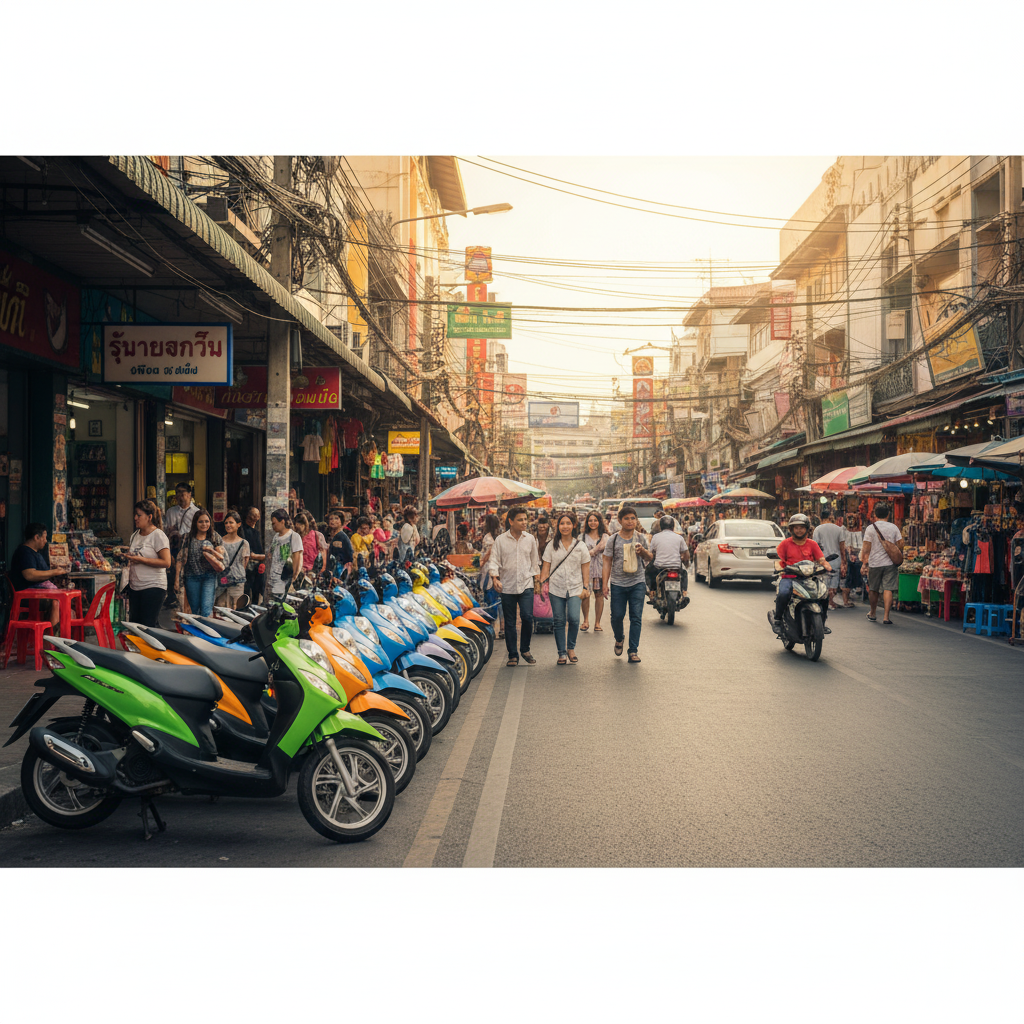
You know that feeling. You’ve just landed in Thailand, the humidity hits you like a warm hug, the smell of lemongrass and exhaust fills the air, and all you want to do is go. You want to see everything. You want to weave through the chaotic, vibrant streets of Bangkok, find that secret beach in Phuket, or cruise up the winding mountain roads of Chiang Mai. To do that properly, you need wheels. Taxi apps are great, and tuk-tuks are a fun novelty for about ten minutes, but they drain your wallet fast. The only real way to experience the Land of Smiles is on a scooter. It’s the ultimate freedom.
But before you rush out and hand over your money to the first guy pointing at a dusty bike on the side of the road, we need to talk numbers. You are probably wondering what the damage is going to be to your wallet.
I’m not going to make you scroll for the answer. The market for Thailand Scooter Rental Cost is pretty established, though it does swing a bit depending on where you are.
Generally speaking, for a standard scooter in 2026, you are looking at a range of 150 to 350 THB per day. That is roughly $4 to $10 USD. It is incredibly cheap compared to renting a car or relying on Grab, but those prices aren’t set in stone. They fluctuate based on the season, the city, and—let’s be honest—how much of a tourist you look like when you walk into the shop. Read more about rental fluctuations at Banana Leaf Travel.
Here is the thing about those street prices, though. They are wild. You might walk into one shop and get quoted 200 THB, walk ten feet down the road, and get quoted 400 THB for the exact same bike because the owner thinks you have nice shoes. It’s exhausting. If you are the type of person who likes to have things sorted before you even pack your bags, check out Byklo. It’s a solid resource for benchmarking. You can see standardized pricing there, which saves you the awkward dance of haggling when you’re jet-lagged and just want to get to your hotel.
So, you have the snapshot. But if you want to keep your budget tight and avoid getting ripped off, we need to break this down further. And if you need a comprehensive step-by-step resource on renting scooters in Thailand, check out our Motorbike Rental Thailand Guide, which covers everything from choosing a bike to final return.
General Price Breakdown (Short vs. Long Term)
When you are trying to figure out how much to rent scooter thailand costs, the biggest factor isn’t actually the bike—it’s the clock. Thailand operates on a bulk discount mentality. The longer you commit to the bike, the less you pay per day. It’s basically the Costco model applied to 125cc engines.
Let’s look at the daily grind first. If you just need a bike for 24 hours to zip around seeing temples or checking out night markets, you are going to pay the premium rate. As I mentioned, this usually lands between 150 and 350 THB. If you see a bike for 150 THB, expect it to have seen some things. It might be an older Honda Click with scratches on the side panels and 50,000 kilometers on the odometer. If you pay 350 THB, you’re usually looking at a brand new model, shiny paint, and brakes that feel snappy. Check out these helpful tips on strict daily rates.
But smart travelers rarely book for just one day. If you are staying in a place for a week, never pay the daily rate multiplied by seven. You are throwing money away. Weekly rates usually range from 900 to 1,800 THB per week. Do the math on that. It brings your daily average down significantly. It also saves you the hassle of having to renew the rental agreement every morning. See more weekly rental tips at Cat Is Out Of The Office.
Now, if you are lucky enough to be staying for a month—maybe you’re living that digital nomad life in Chiang Mai or waiting out the winter in Koh Phangan—the prices drop through the floor. Monthly rentals can go for 2,000 to 4,000 THB per month. That works out to something crazy like 70 to 130 THB a day. You can barely buy a Starbucks coffee for that in the West, and here you get a vehicle. Explore monthly rates in Pattaya here.
We have to talk about the deposit, though. This is where things get sketchy on the street.
Almost every street shop will ask for a deposit. Usually, this is cash, somewhere between 500 and 2,000 THB. That is fine. That is normal.
What isn’t fine—and I cannot stress this enough—is when they ask for your passport.
Do not do it.
Thousands of tourists every year hand over their actual passport as “collateral.” It is a massive risk. If you scratch the bike, or if the shop claims you scratched the bike, they have your passport hostage until you pay whatever extortionate fee they invent. If you lose your rental receipt? Hostage. If you get into an argument? Hostage.
For tips on avoiding these common Thailand motorbike rental scams, check out our detailed guide.
This is where using a platform like Byklo changes the game. When you book through them, the transaction is professional. You aren’t dealing with a random guy who wants to lock your travel documents in a drawer. You keep your passport where it belongs—safely with you. For the most seamless experience, rent a motorbike from Byklo.rent and avoid the roadside hassle.
Pricing by Region (City vs. Islands)
Thailand isn’t one big homogeneous market. Prices bounce around depending on where you are geographically. Supply and demand are very real here.
Let’s start with the capital. The motorbike rental price bangkok offers is usually at the higher end of the spectrum. You are looking at roughly 250 to 400 THB per day. Why? Because Bangkok is a beast. Real estate is expensive for shop owners, demand is high, and the logistics of running a rental fleet in a city with 10 million people are tough. Finding a rental shop in Bangkok can actually be a nightmare, too. Unlike the islands where there is a shop every five meters, Bangkok shops are spread out. You don’t want to be walking three kilometers in the humid city heat looking for a bike. Read more about city rental logistics.
This is a specific scenario where Byklo is a lifesaver. In a sprawling city, you can just look up what is available near your hotel or the BTS station. It saves you wandering around Sukhumvit looking lost.
Then you have the islands—Phuket, Samui, Koh Tao.
The islands run on a specialized “tourist tax.” It’s not an official tax, it’s just the reality that everyone there is on vacation and willing to spend money. Prices generally sit in the 200 to 350 THB range. However, the competition is fierce. On a walk down Patong Beach road, you might pass fifty rental signs. This keeps the price from exploding, but it also means there is a lot of junk on the market. You have to be careful you aren’t renting a rust bucket that’s been sitting in the salt air for five years. Review Thailand gear rentals on Tripadvisor.
Northern Thailand, specifically Chiang Mai and Pai, is the budget paradise.
The vibe up north is chill, and so are the prices. You can find reliable bikes for 150 to 300 THB easily. The roads up there are arguably the best in the country for riding—the Mae Hong Son loop is legendary for a reason—so the bikes tend to be maintained a bit better because they are used for long-distance touring rather than just beer runs to 7-Eleven. Check out rental options in Chiang Mai.
Pricing by Model (Standard vs. Maxi Scooters)
You might be thinking a scooter is a scooter, right? Not exactly.
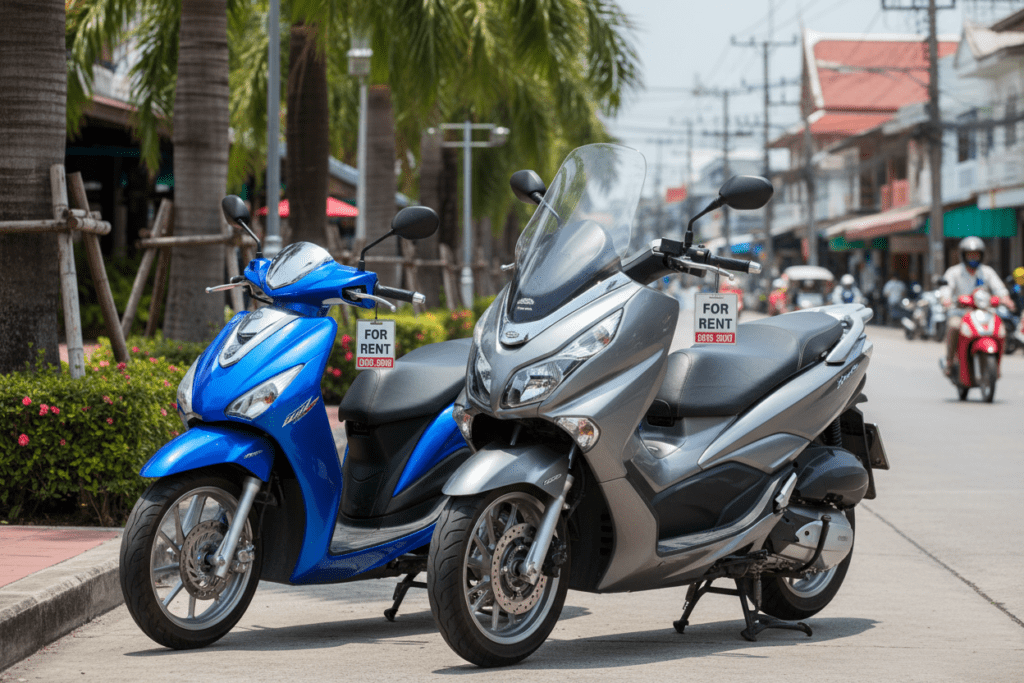
If you go to a rental shop, 90% of what you see will be the Honda Click. This bike is the Toyota Corolla of Southeast Asia. It is bulletproof, easy to ride, and parts are available everywhere. It usually comes in 125cc or 150cc versions.
The average honda click rental price is your baseline for budgeting. Expect to pay between 150 and 300 THB depending on the year. If it’s a shiny new 2026 model with keyless start and LED lights, you pay the 300. If it’s an older model strictly with a key and some battle scars, you pay 150. For most travelers, this bike is perfect. It has enough power to get two people up a hill (slowly) and carries a decent amount of shopping under the seat. Learn more about scooter models in this guide.
But maybe you are a bigger guy, or you plan on doing some serious mileage. Maybe you want to ride from Chiang Mai to Pai and you don’t want your back to hurt after three hours.
That is when you look at the “Maxi Scooters.” The big boys.
The most common ones are the Yamaha NMAX or the Honda PCX. These are like riding a couch. They are wider, heavier, more stable at high speeds, and have way more storage space.
For these, the price jumps. You are looking at 350 to 500 THB per day.
Is it worth it? If you are just driving 10 minutes to the beach in Ao Nang? No. Save your money and get the Click. But if you are planning a road trip or you have a passenger who values their comfort? Absolutely. The PCX absorbs the bumps of Thai roads way better than the smaller bikes.
The Dangers of “Too Cheap” (Quality vs. Cost)
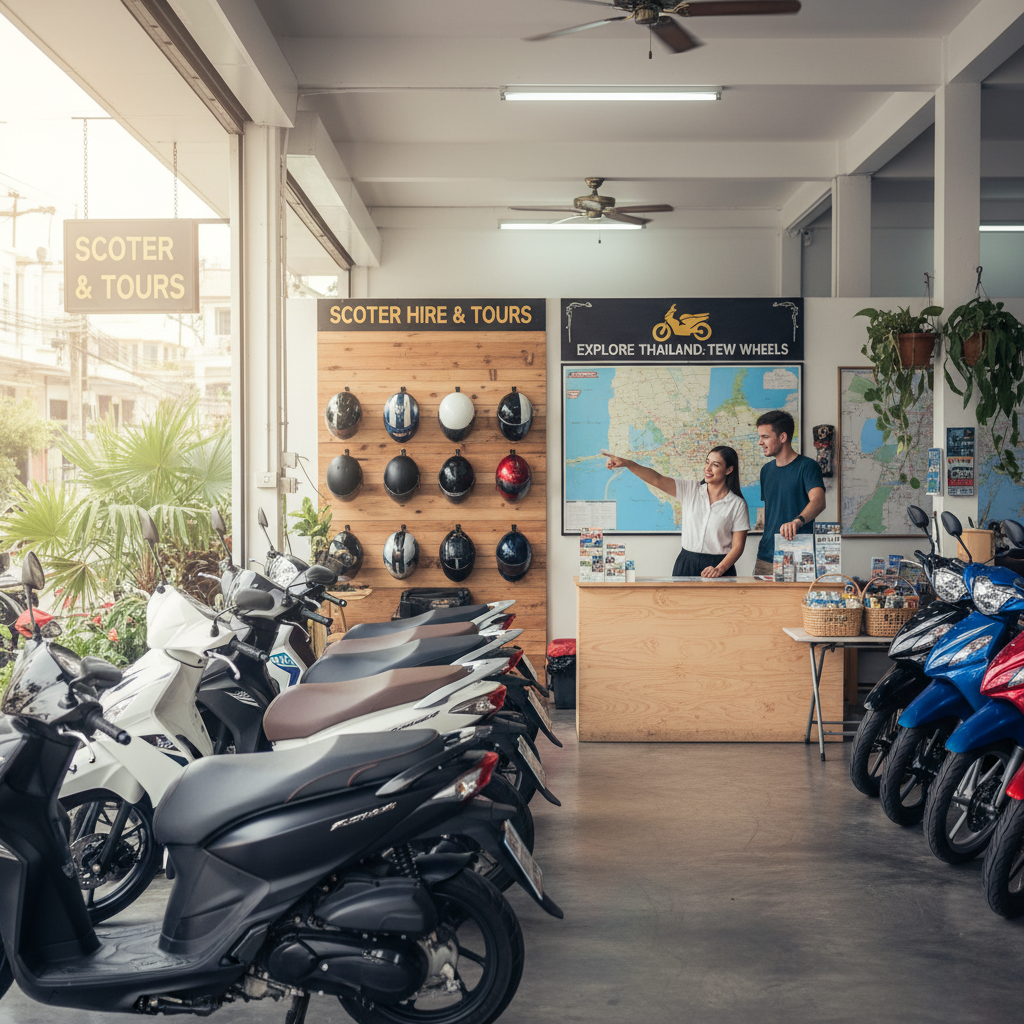
I get it. You want to save money. We all do. You want to spend your cash on Pad Thai and massages, not a rental fee. But there is a very dangerous trap in Thailand when you go looking for the absolute rock bottom price.
If you are actively searching for cheap motorbike hire thailand and you find a place offering bikes for 100 THB or less for a short-term rental, red flags should be going up.
There is a reason that bike is 100 THB.
Usually, it means maintenance has been ignored. We are talking about bald tires that will slide out from under you the second it starts raining. We are talking about brakes that feel like wet sponges and don’t actually stop the bike when a stray dog runs into the road. We are talking about engines that stall at traffic lights. Read safety warnings about cheap rentals.
Driving in Thailand is already risky enough without equipment failure.
Then there are the scams. Some of the seedier “budget” shops make their money on the back end. They rent you an old, scratched-up bike for pennies. Then, when you bring it back, they point to a scratch that was already there—or a scratch that is barely visible—and demand 5,000 THB for “repairs.” Because they have your passport (see, I told you not to give it to them), you are stuck.
This is where the value of Byklo really shines. They focus on verified hosts. You might pay a standard market rate instead of a bargain basement price—say, 250 THB instead of 120 THB. But that extra few dollars is buying you a bike with brakes that work. It’s buying you a bike that won’t leave you stranded in the jungle. It’s buying you assurance that you aren’t walking into a scam.
Think about it. Is saving $3 really worth realizing your brakes don’t work on a steep downhill curve? Probably not.
Hidden Costs to Watch Out For
The rental fee isn’t the only time you open your wallet. There are side costs that people always forget until they happen.
First up is fuel. Thailand fuel is cheap, but it isn’t free.
Most bikes take roughly 100 to 150 THB to fill from empty. The rule in Thailand is almost always “return it as you found it.” If the tank was full, bring it back full. If it was empty (which is annoyingly common), bring it back empty. Just keep an eye on the gauge. There are gas stations everywhere, and in rural areas, you will see locals selling whiskey bottles filled with yellow gasoline on the side of the road. It costs a little more, but it works in a pinch.
Then there is the insurance situation.
Here is a scary fact: most street rentals come with zero insurance. If you crash that bike into a Mercedes, you are paying for the Mercedes. If you total the bike, you are buying the shop a new bike.
This puts a lot of people in financial ruin. Street contracts are often in Thai or broken English, and you have no idea what you are signing.
Always check Byklo to see clear terms regarding insurance coverage. For a deep dive into insurance tiers and how to upgrade your policy, read our Motorbike Rental Insurance Thailand guide. Knowing exactly what your liability is before you start the engine is basic adulting, but so many people skip it.
Finally, we have to talk about the police.
In tourist areas like Phuket, Pattaya, and Chiang Mai, police checkpoints are a daily occurrence. They are looking for two things:
- Are you wearing a helmet?
- Do you have a license?
If you don’t have a helmet, that’s a fine. Usually 500 THB.
If you don’t have a valid license, that’s another fine. Usually 500 to 1,000 THB.
And no, your car license from back home doesn’t count. Legally, you need an International Driving Permit (IDP) with a motorcycle endorsement. If you don’t have the motorcycle stamp on your IDP, you are technically driving illegally. Some rental shops won’t check, but the police definitely will. For a complete walkthrough of Thailand’s license rules and how to secure an IDP, see our Thai Driving License Requirements 2025 guide.
Always budget a little “emergency cash” just in case you run into a checkpoint and realize you forgot your permit at the hotel.
Conclusion
Thailand is an incredible place to explore on two wheels. The wind, the sun, the ability to turn down a random dirt road just because it looks cool—you can’t beat it.
And the Thailand Scooter Rental Cost is honestly a bargain. Even at the high end, you are paying less for a day of transport than you would for a sandwich in New York or London.
But the variation in quality is high. The gap between a good experience and a nightmare usually comes down to where you get your bike.
You can roll the dice on the street, haggle with a guy who wants your passport, and hope the brakes hold up. Or, you can spend the extra $2 a day to get something reliable.
Don’t waste your first day in paradise sweating through your shirt walking from shop to shop. Don’t stress about whether you’re getting scam pricing. Secure your ride today at Byklo for the safest, most transparent rental experience in Thailand. Get it booked, get on the road, and go find that hidden beach.
Ready to skip the scams and secure your scooter? Book now at Byklo.rent and ride with confidence.
Frequently Asked Questions
How much does it cost to rent a scooter in Thailand per day?
Most standard scooters (like the Honda Click 125cc) cost between 150 and 350 THB per day ($4–$10 USD). Prices vary based on location, seasonality, and the age of the bike.
Is it safe to leave my passport as a deposit?
No. You should never leave your actual passport with a rental shop. It is a significant risk if there is a dispute. reputable shops will accept a cash deposit (usually 1,000–3,000 THB) or a copy of your passport instead.
Do I need a special license to drive a scooter in Thailand?
Legally, yes. You need a valid driver’s license from your home country and an International Driving Permit (IDP) with a majestic stamp for motorcycles. Without this, you may be fined by the police, and your insurance may be invalid.
Is insurance included in the rental price?
Typically, no. Most street rentals include zero insurance coverage, meaning you are liable for all damages to the bike and third parties. Platforms like Byklo offer clearer insurance terms so you can ride with peace of mind.